Scalp Reconstruction in NYC
Scalp reconstruction is a specialized category within facial reconstructive surgery that addresses the appearance and function of the scalp following traumatic injury, skin cancer removal, surgical defects, or significant hair loss. The scalp is anatomically distinct from facial skin in several critical ways: it is hair-bearing, considerably thicker, and notably non-elastic compared to the skin of the face. These properties mean that scalp reconstruction follows a different set of surgical principles than the rest of facial reconstruction. Small to medium scalp defects can often be closed by carefully mobilizing the adjacent scalp tissue, but larger defects require alternative strategies — either tissue expansion to grow additional scalp skin gradually, or skin grafting from a different region of the body when scalp coverage cannot be achieved with local tissue alone.
Scalp reconstruction has a unique set of challenges — the scalp’s hair-bearing, thick, and non-elastic skin cannot simply be stretched into place over large defects, and the resulting reconstruction has to preserve hair growth direction and density as well as functional scalp coverage. Dr. Maurice Khosh’s published expertise on the technique most useful for large scalp defects — tissue expansion — directly informs this work. Author of a published chapter on tissue expansion through eMedicine, Dr. Khosh is dual board-certified by the American Board of Facial Plastic and Reconstructive Surgery and the American Board of Otolaryngology–Head and Neck Surgery. A Fellow of the American College of Surgeons (FACS), he has been recognized as a perennial Castle Connolly Top Doctor and a Best Doctors in America honoree.
Why Scalp Reconstruction Is Different from Facial Reconstruction
The scalp’s unique anatomy creates surgical challenges that don’t exist elsewhere on the head and neck:
- Hair-Bearing Skin: Unlike facial skin, the scalp contains hair follicles that grow in specific directions and patterns; reconstruction must preserve both hair growth and natural hair direction to look acceptable
- Thick, Non-Elastic Tissue: Scalp skin has minimal natural stretch, limiting how much it can be advanced or rotated to close defects without creating tension on the closure
- Hairline Considerations: The visible boundary between the hair-bearing scalp and the forehead must be preserved; reconstruction that moves the hairline forward or backward produces a visibly altered appearance
- Galea Aponeurotica: A distinct fibrous layer (galea) sits beneath the scalp skin; its presence affects both how the scalp can be mobilized and how it bleeds during surgery
- Blood Supply Considerations: The scalp has a rich blood supply that supports healing but also requires careful surgical management to prevent excessive bleeding
- Patient Psychological Significance: Hair on the scalp is highly visible and central to many patients’ self-image; reconstruction outcomes affect both function and psychological well-being
When Scalp Reconstruction Is Needed
Several distinct conditions can require scalp reconstruction:
- Skin Cancer Removal: The scalp is a common site of basal cell, squamous cell, and melanoma skin cancers, particularly in patients with extensive sun exposure or thinning hair coverage; defects from Mohs surgery require reconstruction
- Traumatic Injuries: Lacerations, avulsion injuries, animal bites, and other traumatic scalp injuries
- Burns: Thermal, chemical, or electrical burns affecting the scalp
- Congenital Defects: Aplasia cutis congenita (a congenital absence of scalp skin) and other developmental scalp variations
- Surgical Defects: Reconstruction following the removal of large lesions, cysts, or tumors of the scalp
- Post-Surgical Hair Loss: Scarring alopecia following previous procedures, sometimes requiring scalp advancement or expansion
- Severe Pattern Baldness: In selected patients, scalp advancement or reduction procedures can address significant areas of baldness when other approaches are inadequate
Scalp Reconstruction Techniques
The appropriate reconstructive technique depends on the size and location of the defect, the quality of the surrounding scalp tissue, and the patient’s individual goals:
- Primary Closure: For very small defects, the wound edges can be carefully approximated and closed directly with attention to suture technique to minimize visible scarring
- Local Scalp Flaps: For small to medium defects, adjacent scalp tissue is mobilized — rotated, advanced, or transposed — to close the defect with hair-bearing tissue that matches the surrounding scalp
- Galeal Scoring: Strategic relaxing incisions in the galea aponeurotica can allow the scalp to stretch slightly more than its natural elasticity would permit
- Skin Grafts: When sufficient scalp tissue cannot be mobilized, thin or split-thickness skin grafts from a donor site can cover the defect, though these grafts do not contain hair follicles and will produce a hairless area
- Tissue Expansion: For large defects requiring hair-bearing replacement, gradually expanded scalp tissue from nearby intact regions
- Free Tissue Transfer: For very large defects involving loss of scalp, skull bone, or extensive composite tissue, microsurgical transfer of tissue from a distant donor site
- Multi-Stage Reconstruction: Complex cases often require staged procedures to achieve the best result
Tissue Expansion for Large Scalp Defects
For larger scalp defects where adjacent tissue cannot be mobilized into the defect, tissue expansion offers a uniquely effective solution — and one that preserves the hair-bearing nature of the scalp:
- The Technique: A balloon-like expander is placed surgically beneath nearby healthy scalp skin
- Gradual Inflation: Over weeks to months, the expander is gradually inflated with saline through a small port, slowly stretching the overlying scalp skin and increasing its surface area
- Expansion Period: Patients typically come to the office every one to two weeks for incremental expansion; the total expansion period averages two to four months depending on the defect size
- Second Procedure: Once sufficient new scalp tissue has been generated, a second procedure removes the expander and the new scalp tissue is rotated or advanced into the original defect
- Hair Preservation: Because the expanded tissue is the patient’s own hair-bearing scalp, the reconstruction produces a natural-looking, hair-bearing result rather than the hairless area that skin grafting would produce
- Particularly Useful for Pediatric Patients: Tissue expansion is often the preferred approach for children with congenital scalp defects, since it allows for hair-bearing reconstruction during the period of facial growth
“Scalp reconstruction is one of the procedures where the right technique depends almost entirely on the size of the defect and the quality of the surrounding scalp. Small defects close with relatively simple local flaps; medium defects often benefit from galeal scoring or carefully designed rotation flaps; large defects almost always require tissue expansion if hair preservation is the goal. Skin grafting can close the wound, but it leaves a hairless area that most patients are not happy with — so for hair-bearing reconstruction, planning the expansion months ahead is usually the right approach.” — Dr. Maurice Khosh
Hair Preservation in Scalp Reconstruction
For most patients, preserving hair density and natural hair growth direction is one of the most important goals of scalp reconstruction:
- Direction Matters: Hair grows in specific directional patterns across the scalp; reconstruction that disrupts these patterns produces a visibly unnatural appearance even if the wound healing is excellent
- Density Preservation: Reconstructive techniques that use the patient’s own hair-bearing scalp preserve density; techniques like skin grafting produce hairless areas
- Combination Approaches: Some patients benefit from combination approaches — for example, a scalp advancement procedure paired with later hair transplant to refine specific areas
- Hair Transplant as Adjunctive Procedure: For patients with residual hairless areas after reconstruction, follicular unit hair transplantation can be used to add hair density at a later time
Scalp Reconstruction Recovery
Scalp reconstruction recovery varies significantly based on the technique used. Simple local flap reconstructions are often performed under local anesthesia or sedation in the office, with most patients returning to work within seven to ten days. Tissue expansion procedures require a longer overall timeline because of the multi-month expansion period, but the actual surgical recovery from each procedure is relatively straightforward. Skin grafts and free tissue transfer require more involved postoperative care and longer recovery, often involving an inpatient hospital stay. Final results — including the full settling of hair regrowth direction and scar maturation — typically become visible at six to twelve months after the final procedure.
Why Choose Dr. Khosh for Scalp Reconstruction
- Published Tissue Expansion Authority: Author of a peer-reviewed reference on tissue expansion through eMedicine — directly relevant for large scalp defect reconstruction
- Three Decades of Scalp Reconstruction: Refined experience across the full range of scalp reconstructive techniques
- Hair Preservation Focus: Reconstructive planning prioritizes preservation of hair-bearing scalp wherever feasible
- Combination Approach Capability: Scalp reconstruction combined with hair transplantation when appropriate for optimal results
- Full Range of Techniques: Direct closure, local flaps, galeal scoring, skin grafts, tissue expansion, and free tissue transfer all available
- Dual Board Certification: Combined facial plastic and head and neck surgery expertise
- Park Avenue Convenience: Private Upper East Side practice serving patients from across Manhattan and the tri-state area
Schedule Your Scalp Reconstruction Consultation in NYC
During your consultation, Dr. Khosh will evaluate the size and location of the scalp defect, the quality and elasticity of your surrounding scalp tissue, and your aesthetic goals — then discuss the reconstructive options most likely to deliver the result you want. Contact us today to schedule a private consultation for yourself or a family member at his Park Avenue office in New York City, or call (212) 339-9988.
Case Study
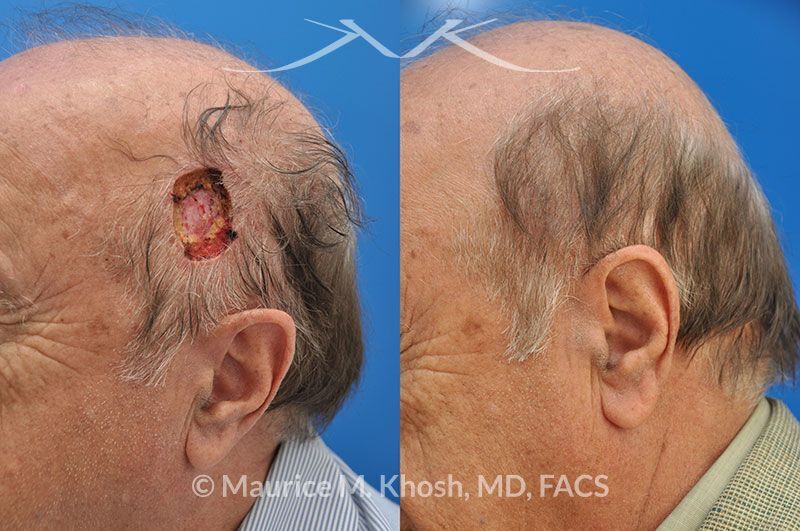
This 64-year-old gentleman sought consultation for repair of scalp skin in Manhattan. He had a basal cell skin cancer removed with the Moh’s technique. The resulting scalp defect was repaired with a rotation-advancement flap.
- Patient: 64 year old male candidate for scalp skin reconstruction
- Problem: 2-inch scalp defect following skin cancer removal
- Procedure: In this case, local rotation-advancement flap allowed repair of the defect. More generally, surgical treatment of scalp defects may necessitate tissue expansion, hair grafts, or secondary scar revision.
Disclaimer: These are actual results for patients of Dr. Maurice Khosh. Plastic and cosmetic surgery results can vary between patients.
Frequently Asked Questions
-
Small scalp defects can be reconstructed under local anesthesia. Larger defects that require more complicated procedures such as scalp flaps or tissue expansion are best performed under sedation or general anesthesia in an operating room.
-
Tissue expansion or scalp expansion is a very useful technique in repairing large defects of the scalp. Scalp tissue is stiff compared to other parts of the body, and cannot be stretched very far. Tissue expansion is used for repair of traumatic defects, cancer defects and scalp baldness.
-
Following a surgical procedure to place the tissue expander, patients come to the office two or three times weekly to undergo expander injections. The duration of expansion is dependent on the size of the tissue expander. Tissue expanders come in various sizes and shapes depending on the size and location of the defect. Tissue expansion may take 4 to 8 weeks.
-
Skin grafts are pieces of skin that are harvested from one area of the body and attached to a recipient site such as the scalp. Skin grafts do not grow hair. Although the skin graft procedure is generally simpler than a scalp flap, the cosmetic appearance is inferior to a scalp flap.
Related Procedures
Scalp reconstruction is usually a stand alone procedure. However, reconstruction may require multiple stages. In particular, with tissue expansion, an initial expander placement is followed with serial injections during office visits. Once the expander has reached the desired size, it is then removed during a surgical procedure when the expanded tissue is rearranged on the scalp.
Click Here to See Scalp Photo Gallery