Scar Revision
The goal of scar revision is rarely scar elimination — the body cannot heal a wound without forming some kind of scar. The actual goal is making the scar significantly less visible, less raised, less depressed, or less distortive than it was before. Almost any injury can leave a scar on the face: burns, acne, lacerations, surgical incisions, animal bites, falls, and many other traumatic or medical events. Even something as minor as a healed pimple can leave behind a permanent skin change. While scarring is the body’s natural healing process, the resulting tissue can deform the smooth surface of the skin and meaningfully affect a patient’s self-confidence. Scar revision is one of the procedures within facial reconstruction at Dr. Khosh’s Park Avenue practice in New York City.
Scar revision is one of the few procedures where the surgeon’s published expertise is directly relevant to the work performed in the office. Dr. Maurice Khosh authored “Surgical Treatment of Facial Scars” — a published chapter through Thieme Publishers — that informs his approach to every scar revision he performs. Dual board-certified by the American Board of Facial Plastic and Reconstructive Surgery and the American Board of Otolaryngology–Head and Neck Surgery and a Fellow of the American College of Surgeons (FACS), Dr. Khosh has been recognized as a perennial Castle Connolly Top Doctor and a Best Doctors in America honoree.
Types of Scars That Can Be Revised
Facial scars take many different forms, and the appropriate revision technique varies with the scar type. Dr. Khosh treats a wide range of scar types:
- Hypertrophic Scars: Wide, thickened scars that remain within the boundaries of the original incision
- Keloid Scars: Raised scars that grow beyond the boundaries of the original wound (see also keloid scar treatment)
- Depressed (Atrophic) Scars: Scars that have healed below the level of the surrounding skin, including ice-pick and boxcar acne scars
- Stretched or Wide Scars: Original incisions or wounds that have spread over time as the surrounding tissue moved
- Contracture Scars: Tight scars often resulting from burns, capable of restricting movement or distorting nearby features
- Discolored Scars: Scars that have healed with a color that contrasts visibly with the surrounding skin
- Misaligned Scars: Scars that cross natural skin tension lines and remain visible regardless of color or thickness
- Surgical Scars: Old incisions from previous procedures that did not heal as well as the patient hoped
Why Scar Revision Is More Complex Than It Sounds
Removing or reducing the appearance of scar tissue is more complicated than simply cutting it out — that approach would create a new scar in place of the old one. Effective revision involves carefully analyzing what makes the existing scar visible (depth, width, color, orientation relative to skin tension lines, surrounding tissue distortion) and addressing each of those factors individually. Some scars require surgical excision and meticulous re-closure along natural skin lines; others respond better to non-surgical treatments such as steroid injections, laser resurfacing, or dermabrasion. Some difficult cases may require several procedures spaced months apart to achieve a meaningful improvement. Each patient’s scar is examined individually and a treatment plan is built around the specific type of scar, the patient’s skin characteristics, and the anatomical location.
In some cases, scar revision needs to be combined with broader facial reconstruction — particularly when the original injury affected underlying muscle, bone, or anatomical structures beneath the skin. Dr. Khosh’s training in both facial plastic and head and neck surgery allows him to address scar revision as part of a comprehensive treatment plan when the situation requires it.
“The most important conversation in scar revision is about realistic expectations. Some scars can be made nearly invisible; others can be significantly improved but never eliminated entirely. Understanding which category a particular scar falls into — and explaining that clearly to the patient before treatment — is what separates a satisfied outcome from a disappointed one.” — Dr. Maurice Khosh
Why the 12-Month Waiting Period Matters
In most cases, a scar should be allowed to heal and mature for twelve months or more before revision is attempted. This waiting period is essential for several reasons. Newly healed scars are still actively remodeling — collagen is being deposited, broken down, and reorganized — and the appearance of the scar can change substantially during the first year. A scar that looks raised or red at three months may flatten and fade significantly by twelve months without any intervention. Revising a scar before it has fully matured risks operating on tissue that would have improved on its own, and may produce a worse result than waiting would have. For specific cases involving severe contracture, functional impairment, or psychologically distressing visible scars, the timeline can be adjusted, but for most aesthetic concerns, patience is part of the treatment.
Case Study
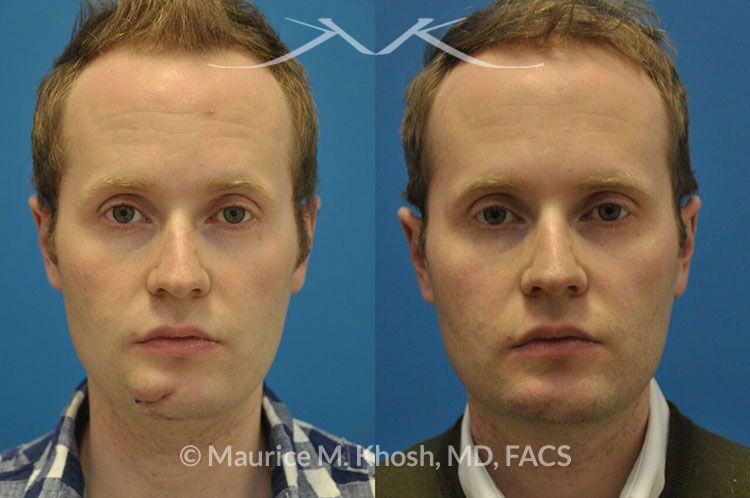
This 25 year old man had suffered a traumatic injury to his chin. The skin and muscle layers had healed in an irregular way causing a depressed appearing scar with adjacent soft tissue swelling causing a very obvious deformity. During scar revision, the muscle layers were repaired and the skin was re approximated precisely.
- Patient: 25 year old man seeking scar revision in New York
- Problem: Depressed skin edges and swelling of the adjacent soft tissues
- Procedure: Scar revision to realign the muscles and the skin
Disclaimer: These are actual results for patients of Dr. Maurice Khosh. Plastic and cosmetic surgery results can vary between patients.
Why Patients Choose Dr. Khosh for Scar Revision
- Published Scar Treatment Authority: Author of “Surgical Treatment of Facial Scars” through Thieme Publishers
- Individualized Treatment Plans: Each scar evaluated for its specific characteristics rather than treated with a single default approach
- Multi-Modality Capability: Surgical excision, laser resurfacing, dermabrasion, steroid injections, and combination approaches available
- Realistic Expectation Setting: Honest conversation about what scar revision can — and cannot — accomplish for each individual scar
- Dual Board Certification: Combined facial plastic and head and neck surgery expertise
- Park Avenue Convenience: Private Upper East Side practice serving patients from across Manhattan and the tri-state area
Schedule Your Consultation in Manhattan
If you are ready to begin seeking scar revision treatment — and your scar is at least twelve months old — the first step is an honest evaluation of the existing scar and a discussion of what improvement is realistically achievable. To schedule your private consultation with Dr. Khosh at his Manhattan office, contact the office of Dr. Khosh today, or call (212) 339-9988.

Click Here to See Scar Revision Photo Gallery