Facial Paralysis Treatment
Facial paralysis is one of the most distressing conditions a patient can face — both for its visible impact and for the practical difficulties it creates with everyday function. The paralysis can arise from a number of underlying causes, including stroke, cancer treatment, traumatic injury, or as a complication of ear or parotid gland surgery. The effects can be temporary or permanent, mild or severe, and may involve only a segment of the face or its entire half. Beyond the cosmetic concerns, paralysis of the face causes the inability to move the brow or close the eye, significant difficulty with speech and swallowing, and emotional consequences that often include withdrawal and depression. If not treated properly, the condition can lead to visual loss from eye injury and malnutrition from swallowing problems. Facial paralysis treatment is one of the surgical options within facial reconstruction at Dr. Khosh’s Park Avenue practice in New York City.
Treating facial paralysis demands intimate knowledge of facial nerve anatomy — the kind of knowledge gained through years of operating in the head and neck region where this nerve runs. Dr. Maurice Khosh’s dual board certification was earned in exactly that territory. Certified by both the American Board of Facial Plastic and Reconstructive Surgery and the American Board of Otolaryngology–Head and Neck Surgery, and a Fellow of the American College of Surgeons (FACS), he has spent three decades operating around the facial nerve and its branches. Dr. Khosh has been recognized as a perennial Castle Connolly Top Doctor and a Best Doctors in America honoree.
Causes of Facial Paralysis
Facial paralysis can develop from a wide range of medical conditions and events:
- Stroke: Cerebrovascular events that affect the area of the brain controlling facial movement
- Cancer Treatment: Tumors of the parotid gland, skull base, or surrounding structures, and the surgical or radiation treatments required to address them
- Traumatic Injury: Direct injury to the facial nerve from fractures or lacerations
- Complication of Ear or Parotid Surgery: Inadvertent injury to the facial nerve during procedures in the vicinity of the parotid gland or middle ear
- Bell’s Palsy: An idiopathic condition that produces sudden facial weakness, usually temporary
- Congenital Conditions: Facial paralysis present from birth, often associated with specific congenital syndromes
- Infection: Viral infections such as herpes zoster (Ramsay Hunt syndrome) and severe ear infections that affect the nerve
Management of Facial Paralysis
The management approach depends on the severity of the weakness, the expected degree of recovery, and the extent of facial involvement. When paralysis is expected to be temporary — such as in many cases of Bell’s palsy — conservative measures may be sufficient. These include careful eye lubrication to prevent corneal injury, speech and swallow therapy to maintain function, and watchful observation as the nerve recovers. If the paralysis is likely to be permanent, surgical maneuvers are often necessary to protect the eye, allow for better lip function, elevate or suspend the face, or in some cases, restore natural facial movement.
Cosmetic Surgery for Facial Paralysis
Dr. Khosh offers a comprehensive range of surgical options to address facial paralysis, each tailored to the specific functional and aesthetic concerns the patient is facing:
- Brow Lift and Facelift: Cosmetic surgical techniques used to elevate or suspend droopy facial muscles and skin on the paralyzed side, restoring facial symmetry
- Gold-Weight Eyelid Placement: A small wafer of gold is placed in the upper eyelid to help it close completely, protecting the eye from corneal injury and exposure
- Static Mouth Closure (Sling Procedures): Surgical slings extending from the cheekbone to the corner of the mouth provide passive support to the paralyzed lip
- Temporalis Muscle Transfer: A more dynamic option in which the temporalis muscle is transferred from the temple to the corner of the mouth, allowing the patient to close the mouth through active muscle effort
- Hypoglossal-Facial Nerve Transfer: A nerve transfer using the hypoglossal nerve (which controls tongue movement) to restore facial movement on the paralyzed side
- Cross-Facial Nerve Transfer: A nerve transfer that bridges nerve fibers from the healthy side of the face to the paralyzed side, restoring more natural and symmetric facial expression
- Botox for Minor Asymmetries: Simple office-based treatments with neuromodulator can help fine-tune minor persistent facial asymmetries after surgical reconstruction
“Facial paralysis treatment is one of the few areas of facial plastic surgery where the goal is not refinement — it’s restoration of function. Closing the eye, achieving lip closure, restoring some degree of symmetry. The hierarchy of priorities is functional first, aesthetic second, and the surgical plan must reflect what the patient needs most urgently.” — Dr. Maurice Khosh
Multi-Specialty Coordination
Comprehensive care for facial paralysis often requires coordination with several other specialists. Dr. Khosh works closely with neurologists, ophthalmologists, speech and swallow therapists, and the cancer or ear surgeons whose work may have preceded the paralysis. Timely coordination with this broader care team is essential — particularly during the first weeks and months after the paralysis develops, when the right combination of conservative measures, eye protection, and surgical planning has the greatest influence on long-term outcomes.
Why Patients Choose Dr. Khosh for Facial Paralysis Treatment
- Head and Neck Surgical Training: Trained in the specialty where facial nerve anatomy is core clinical territory
- Three Decades of Operating Around the Facial Nerve: Deep familiarity with the nerve’s course, branches, and the surrounding anatomy
- Comprehensive Treatment Range: From conservative eye protection to gold-weight placement, nerve transfers, muscle transfers, and refinement injections
- Multi-Specialty Coordination: Established working relationships with neurologists, ophthalmologists, speech/swallow therapists, and the surgeons whose original procedures may have been related to the paralysis
- Park Avenue Convenience: Private Upper East Side practice serving patients from across Manhattan and the tri-state area
Schedule Your Consultation in Manhattan
If you or a loved one is dealing with acute or long-standing facial nerve dysfunction, the first step is a thorough evaluation of what can be expected from natural recovery and what surgical options can improve function, protect the eye, and restore symmetry. Please contact us today to schedule a private consultation with Dr. Khosh at his Park Avenue office in New York City, or call (212) 339-9988.
Case Study
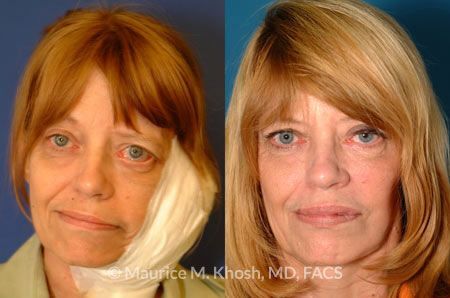
This 58-year-old lady had developed facial paralysis following removal of a skin cancer on her face, which involved the facial nerve. She had multiple procedures to achieve movement and symmetry in her face.
- Patient: 58-year-old female candidate for facial paralysis repair
- Problem: Paralyzed face after skin cancer removal
- Procedure: Facial nerve graft, forehead lift, facelift, belpharoplasty, gold-weight implant to upper eyelid
Disclaimer: These are actual results for patients of Dr. Maurice Khosh. Plastic and cosmetic surgery results can vary between patients.
Frequently Asked Questions
-
Bell’s palsy is another name for facial paralysis of unknown origin. Bell’s palsy is the most common cause of facial paralysis. Other causes of facial paralysis include: stroke, trauma, tumors affecting the facial nerve, or infections such as Lyme’s disease or syphilis.
-
Eye protection is the most pressing problem for individuals with facial paralysis. Facial paralysis results in an inability to close the eye. The eye may become dry, painful, and infected. In worst-case scenarios, vision may be affected. The number one goal is allowing adequate eye closure and keeping the eye surface moist.
-
Recovery in facial paralysis is dependent on the original cause of the paralysis. Patients with Bell’s palsy, have an excellent prognosis, especially when treatment with steroids is started in timely manner. Paralysis due to infections has a good prognosis once the infection has been effectively treated. Facial paralysis due to nerve disruption either from trauma or cancer is permanent. In these cases, nerve grafts or nerve transpositions can have a highly functional effect, when instituted within one year of the onset of paralysis.
-
This depends on the type of procedure involved. Small procedures such as gold weight placement in the upper eyelid can be done under local anesthesia. More complicated procedures such as facial nerve grafts, temporalis flaps, brow lift, or facelift surgery require sedation of general anesthesia in an operation room.
Related Procedures
Treatment of facial paralysis often involves a combination of procedures aimed at improving both function and aesthetics of the face. There are a variety of “cosmetic procedures” that have a functional role in patients with facial paralysis. These include: facelift surgery, brow lift, blepharoplasty, and Botox injections.