Earlobe Keloid Treatment
Earlobe keloids are one of the most common — and most stubbornly recurrent — scar conditions in facial plastic surgery. They develop when the body’s healing response to a piercing, injury, or surgical incision goes beyond what is needed to close the wound, producing an overgrowth of raised, often firm scar tissue that can extend well beyond the original site. Most earlobe keloids form months after a piercing, frequently beginning as a small bump that gradually enlarges over weeks or years. While keloids can occur in any patient, they are significantly more common in individuals with African, Asian, Hispanic, or Mediterranean heritage, and they frequently run in families. Earlobe keloid treatment is one of the ear procedures Dr. Khosh performs at his Park Avenue practice in New York City.
Treating earlobe keloids well is more challenging than most patients expect. Simple excision alone has a recurrence rate as high as 50 to 100 percent — meaning that without the right combination of techniques, the keloid is likely to return. Few facial plastic surgeons in New York bring the depth of published scar expertise that Dr. Maurice Khosh offers. Dual board-certified by the American Board of Facial Plastic and Reconstructive Surgery and the American Board of Otolaryngology–Head and Neck Surgery, Dr. Khosh is a Fellow of the American College of Surgeons (FACS) and a Clinical Assistant Professor at Columbia University. He is the author of “Surgical Treatment of Facial Scars” — a published chapter through Thieme Publishers (2014) — work that directly informs his approach to scar revision and recurrence prevention across the face and ears. Recognized as a perennial Castle Connolly Top Doctor and a recipient of the Patients’ Choice Award, Dr. Khosh combines surgical precision with the careful follow-up planning that earlobe keloid treatment demands.
What Causes Earlobe Keloids
Keloids are the result of an exaggerated healing response in genetically susceptible patients. When the skin is injured, the body produces collagen to repair it; in patients prone to keloids, this collagen production continues well past the point of normal scar formation, building up into the raised, firm tissue patients see. Common triggers include:
- Ear Piercing: The most common cause, particularly in patients with a family history of keloids
- Earlobe Trauma: Cuts, lacerations, or torn earlobes from heavy earrings or accidents
- Previous Earlobe Surgery: Any procedure on the earlobe can trigger keloid formation in susceptible patients
- Cosmetic Procedures: Including stretched earlobes that have been re-pierced or repaired
- Infections: Untreated piercing infections can produce inflammation that contributes to keloid development
How Earlobe Keloids Are Treated
There is no single treatment that works for every earlobe keloid — the most successful approach almost always combines surgical excision with one or more additional therapies designed to prevent recurrence. Dr. Khosh tailors the treatment plan to each patient’s specific situation:
- Surgical Excision: Precise removal of the keloid tissue with careful closure to minimize tension on the healing wound
- Intralesional Steroid Injections: Injected at the time of surgery and at subsequent follow-up visits to suppress excessive scar formation
- Pressure Therapy: Specialized compression earrings worn for several months after surgery to discourage keloid regrowth
- Silicone Sheeting: Adhesive silicone gel sheets applied to the healing site to support the maturation of normal scar tissue
- Combined Approach: For larger or recurrent keloids, multiple modalities are layered together for the best chance of long-term resolution
“Earlobe keloids are one of those conditions where the surgery is the easy part — the long-term result depends on what happens in the months after. Combining excision with steroid injections, pressure therapy, and consistent follow-up is what produces a real cure, not just a temporary improvement. Anyone offering keloid treatment without that follow-up plan is offering a fifty-fifty chance.” — Dr. Maurice Khosh
What to Expect from the Procedure
Earlobe keloid excision is typically performed under local anesthesia in Dr. Khosh’s Park Avenue office. The procedure usually takes 30 to 60 minutes depending on the size and complexity of the keloid. After cleansing and numbing the area, Dr. Khosh carefully removes the keloid tissue and closes the wound with fine sutures designed to minimize tension. In most cases, an initial intralesional steroid injection is administered at the conclusion of the procedure. Patients are sent home the same day with a small dressing and detailed care instructions. Most return to work and social activities within a day or two, with stitches typically removed in seven to ten days.
Preventing Recurrence
Because recurrence is the central challenge with earlobe keloids, Dr. Khosh emphasizes a structured follow-up plan that typically extends six to twelve months after the initial procedure. This usually includes a series of intralesional steroid injections at four- to six-week intervals during the healing period, the consistent use of pressure earrings, and regular check-ins to monitor for any early signs of regrowth. Patients who follow the recommended post-treatment plan have significantly better long-term outcomes than those who pursue excision alone.
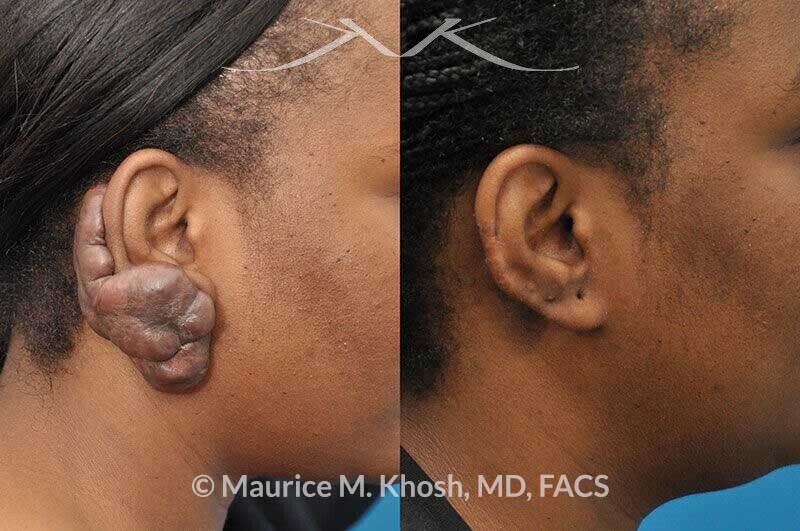
Case Study
This 30 year old lady sought treatment for large recurrent right ear keloids. Shee had undergone two failed treatments of keloids for her ear. The large keloids was successfully treated with surgical excision and steroid injections.
- Patient: 30 year old lady with recurrent right ear keloids
- Problem: Large and deforming right ear keloid
- Procedure: Excision of keloid and repair followed by steroid injections
Disclaimer: These are actual results for patients of Dr. Maurice Khosh. Plastic and cosmetic surgery results can vary between patients.
Why Patients Choose Dr. Khosh for Earlobe Keloid Treatment
- Published Scar Treatment Authority: Author of “Surgical Treatment of Facial Scars” through Thieme Publishers (2014)
- Combined Multi-Modality Approach: Surgical excision paired with steroid injections, pressure therapy, and structured follow-up
- Dual Board Certification: The earlobe and surrounding tissue are core anatomical regions for both facial plastic and head and neck surgery training
- Realistic Expectations: Honest conversation about recurrence rates and the commitment required for long-term success
- Park Avenue Convenience: Private Upper East Side practice serving patients from across Manhattan and the tri-state area
Schedule Your Consultation in Manhattan
Whether your earlobe keloid is small and recent or large and recurrent after previous attempts at treatment, the right outcome depends on a comprehensive, individualized plan that addresses both the visible tissue and the underlying tendency for it to return. To schedule a consultation with Dr. Khosh at his Park Avenue office in New York City, call (212) 339-9988 or contact us online to request an appointment.