Non-Surgical Facelift
Not every sign of aging requires surgery to address. While a surgical facelift remains the most comprehensive and longest-lasting solution for advanced skin laxity, advances in injectable, energy-based, and resurfacing technologies now allow many patients to rejuvenate the face without an incision — and to do so with results that look natural and require only minimal downtime.
Few facial plastic surgeons are positioned to evaluate this trade-off as accurately as Dr. Maurice Khosh. Dual board-certified by the American Board of Facial Plastic and Reconstructive Surgery and the American Board of Otolaryngology–Head and Neck Surgery, Dr. Khosh is a Fellow of the American College of Surgeons (FACS) and a Clinical Assistant Professor at Columbia University. After completing his head and neck surgery residency at Columbia and his facial plastic surgery fellowship at the University of Washington, he has spent three decades performing both surgical facelifts and the full range of non-surgical options — from the deep plane facelift to liquid facelift techniques — meaning each patient’s recommendation is grounded in surgical anatomy rather than in the limits of any one technology. In 2023, he was an invited lecturer on non-surgical techniques at the Minimally Invasive ENT/Open Forum, reflecting his standing in the rapidly evolving field of injectable and energy-based facial rejuvenation. He is a perennial Castle Connolly Top Doctor and a recipient of the New York Magazine Best Doctor in Facial Plastic Surgery award.
“The honest conversation in facial rejuvenation is about what each approach can and cannot deliver. Non-surgical techniques can do remarkable things for the right patient — but they cannot replicate what a facelift does for advanced laxity. Knowing where that line falls, and being able to perform both, is what allows the recommendation to fit the patient rather than the other way around.” — Dr. Maurice Khosh
Liquid Facelift
The non-surgical facelift is often called a liquid facelift because it relies on liquid injectables — rather than the scalpel and sutures of traditional surgery — to produce its lifting, volumizing, and contouring effects. A combination approach is typically built from several modalities working together: hyaluronic acid fillers (such as Juvéderm or Restylane) and biostimulatory fillers (such as Sculptra or Radiesse) restore midface volume and re-elevate sagging contours; neuromodulators such as Botox, Dysport, or Xeomin soften dynamic wrinkles across the forehead, brow, and crow’s-feet area; and targeted injectable treatments such as Kybella dissolve small fat deposits beneath the chin to refine the jawline. Laser resurfacing is frequently added to address the surface layer of the skin — improving tone, refining texture, and stimulating new collagen formation in the dermis. Together, these treatments can deliver a refreshed, lifted appearance without the risk or recovery time of facelift surgery. The trade-off is durability: most injectables maintain their effect for six months to two years depending on the product, with periodic maintenance treatments required to preserve the result over time.
To explore both the surgical and non-surgical options available for facial rejuvenation, contact us today to schedule a consultation with Dr. Khosh at his Manhattan office.
Case Study
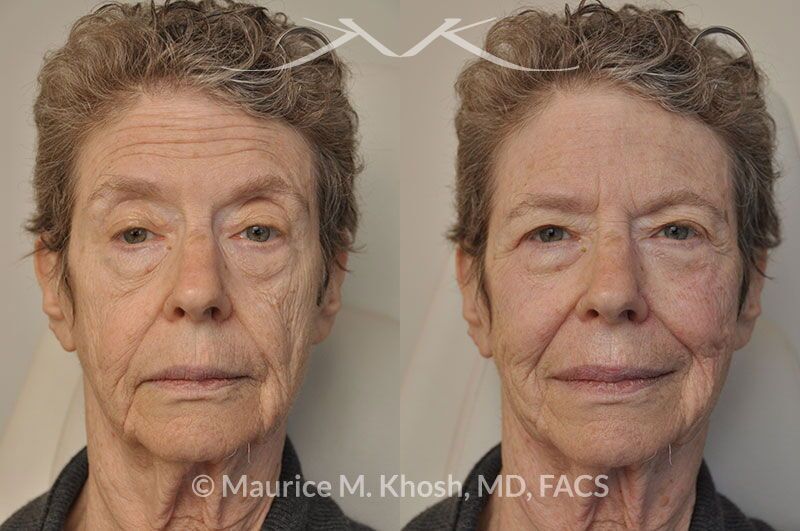
This 71-year-old lady sought consultation for non surgical facial rejuvenation in Manhattan. She wanted a younger and more youthful facial appearance without any surgery or down time.
- Patient: 71-year-old female candidate for Voluma facial enhancement
- Problem: Loss of facial fat and volume in the cheeks and mid face
- Procedure: Voluma injection. 3 vials of Voluma injected into the cheeks and the mid face.
Disclaimer: These are actual results for patients of Dr. Maurice Khosh. Plastic and cosmetic surgery results can vary between patients.
Frequently Asked Questions
-
Botox Cosmetic, Xeomin, or Dysport effects last about four months. Juvederm and Restylane maintain their effect for six to nine months. Voluma is one of the newest fillers on the market which lasts up to two years. Radiesse lasts about one year, and Sculptra can last up to two years. Laser resurfacing can erase up to five years of aging from the skin.
-
Botox Cosmetic, Xeomin, and Dysport injections manifest their results in two to seven days. Restylane, Juvederm, Voluma, and Radiesse effects are seen immediately. Sculptra takes two months to show the outcome. Laser skin resurfacing results won’t be fully manifest for three months.
-
No. The treatments that are mentioned entail a comprehensive list of available options. The particular steps for each patient need to be tailored to their needs.
-
Patients may immediately return to work after Botox Cosmetic or filler injections. Laser resurfacing will require five days of recovery.
-
Yes.
-
Bruising from Botox Cosmetic or filler injections is very uncommon. Makeup can effectively camouflage any bruising.
-
Since non-surgical facelift does not entail surgery or scarring, it may be repeated as often as necessary. In fact, most patients repeat treatments as the effects wear off.
Related Procedures
Non-surgical facial rejuvenation is a wonderful way of reversing sings of aging without the need for a recovery period. Occasionally surgical treatments with minor recovery can complement non-surgical rejuvenation. Procedures such blepharoplasty, neck liposuction, or chin implant placement entail a short recovery and address areas that non-surgical face lift can not address.
Click Here to See Face Lift, Neck Lift Photo Gallery