Facial Fracture Repair
Facial fractures can result from accidental falls, sports injuries, motor vehicle accidents, or assaults, and most require surgical repair because of their aesthetic and functional consequences. Nose fractures are by far the most common type of facial fracture, but the forehead, cheekbones, orbital bones (the bone surrounding the eye), and jawbones can also be fractured or displaced by significant trauma. Severe facial injuries require emergency evaluation to assess the extent of damage and to rule out concomitant injuries to the eye, brain, or neck. Primary surgical management of facial fractures is often delayed by seven to ten days after the initial injury to allow the reduction of soft tissue swelling — operating too early can compromise both the surgical view and the eventual aesthetic outcome. Facial fracture repair is one of the surgical options within facial reconstruction at Dr. Khosh’s Park Avenue practice in New York City.
Repairing a facial fracture well means accomplishing two things at once: restoring the underlying skeletal alignment and protecting the overlying soft tissue and visible features from permanent change. Dr. Maurice Khosh’s training is built for exactly this combination. Dual board-certified by the American Board of Facial Plastic and Reconstructive Surgery and the American Board of Otolaryngology–Head and Neck Surgery, he trained in the head and neck surgical specialty where facial trauma evaluation and repair is core clinical territory. A Fellow of the American College of Surgeons (FACS), Dr. Khosh has authored published references on implant-based facial contouring, work that informs his approach to the bone grafts and inert implants sometimes required for more severe fractures. He has served on the American Academy of Facial Plastic and Reconstructive Surgery’s Board Examination and Continuing Education Committees, contributing to the national standards of practice in his field.
Facial Fracture Surgery
Radiographic (CT scan) examination of the face allows precise evaluation of bony injuries and is typically performed during the initial emergency room visit. Dr. Khosh treats both primary facial fractures — those addressed shortly after the initial injury — and secondary deformities from old facial injuries that healed incorrectly or were never properly repaired.
The surgical approach varies depending on the fracture type:
- Nasal Fractures: The only type of facial fracture that can be repaired in an office setting under local anesthesia, with most cases addressed within the first two weeks after injury
- Orbital (Eye Socket) Fractures: Often involve coordination with an ophthalmologist to ensure no damage to the eye itself, with surgical repair through hidden incisions
- Cheekbone (Zygoma) Fractures: Require precise repositioning of the cheekbone to restore facial symmetry and protect the underlying eye structures
- Forehead and Frontal Sinus Fractures: May require coordination with neurosurgical specialists if the fracture extends close to the brain or sinus cavities
- Jaw and Mandibular Fractures: Require careful coordination with oral surgeons and dentists to ensure proper alignment and preserve dental function
- Multi-Site Fractures: Severe injuries that affect multiple facial bones, requiring a comprehensive, multi-specialty approach
For more severe facial fractures, Dr. Khosh works closely with ophthalmologists, dentists, oral surgeons, and neurosurgeons to ensure comprehensive, coordinated care.
“Facial fracture repair is one of the few procedures where the work has to be both technically precise and aesthetically considered at the same time. The bones underneath determine the contour of the face you see in the mirror — and small errors in alignment produce visible asymmetry that can be very difficult to correct later. The conversation with the patient is always about restoring not just function, but appearance.” — Dr. Maurice Khosh
Surgical Techniques and Approach
Dr. Khosh utilizes the most modern surgical techniques and specialized instrumentation to repair facial fractures through hidden incisions placed inside the mouth, along the inside of the eyelid, or within the hairline — eliminating any visible facial scarring. The choice of approach depends on the specific fracture being addressed and the surgical access required. For more severe fractures, bone grafts or inert implants may be used to restore the original facial structure and prevent long-term aesthetic distortion.
Secondary facial reconstruction is performed for patients with old fractures that healed improperly or were never adequately treated. These corrective procedures can restore forehead or cheekbone depressions, address a sunken eyeball position from an inadequately repaired orbital fracture, or correct a displaced jawbone causing dental malocclusion. Each secondary reconstruction is individually planned based on the existing anatomy and the patient’s specific aesthetic and functional goals.
Why Patients Choose Dr. Khosh for Facial Fracture Repair
- Head and Neck Surgical Training: Trained in the specialty where facial trauma evaluation and repair is core clinical territory
- Three Decades of Facial Reconstructive Experience: Both primary fractures and secondary corrections of old injuries
- Multi-Specialty Coordination: Established working relationships with ophthalmologists, dentists, oral surgeons, and neurosurgeons for complex cases
- Hidden Incision Approach: Surgical access through the mouth, eyelid, or hairline to eliminate visible facial scarring
- AAFPRS Standards Leadership: Service on the American Academy’s Board Examination and Continuing Education Committees
- Park Avenue Convenience: Private Upper East Side practice serving patients from across Manhattan and the tri-state area
Schedule Your Consultation in Manhattan
Whether your concern is a recent facial fracture requiring primary repair or an old injury that healed in a way you would like to correct, the first step is a thorough evaluation of the underlying anatomy and an individualized surgical plan. Contact our office today to schedule a consultation with Dr. Khosh at his Park Avenue office in New York City, or call (212) 339-9988.
Case Study
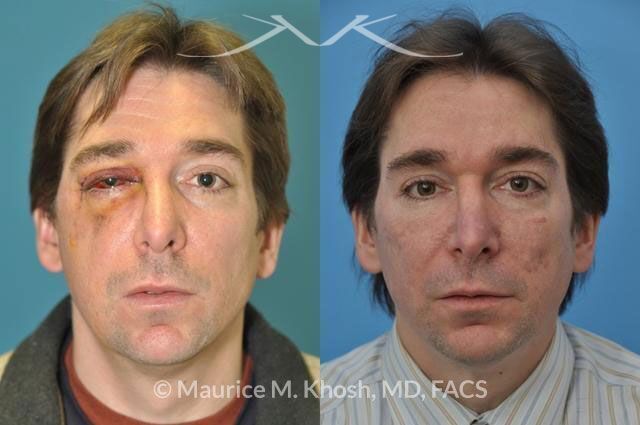
This 41-year-old gentleman requested consultation for repair of cheekbone fracture, in New York, after a fall injury. The facial bones were repaired through hidden incisions inside the mouth and inside the lower eyelid.
- Patient: 41-year-old candidate for facial bone fracture repair
- Problem: Displaced orbital rim and cheekbone fracture
- Procedure: Repair of facial fracture with titanium plates
Disclaimer: These are actual results for patients of Dr. Maurice Khosh. Plastic and cosmetic surgery results can vary between patients.
Frequently Asked Questions
-
Acute nasal fractures may be repaired under local anesthesia during an office visit. All other facial fractures, and secondary repair of nose fractures are best performed under general anesthesia or deep sedation in an operating suite.
-
The optimum time for repair of facial fractures is about one week after the injury. This will permit the initial swelling to subside. Waiting beyond two weeks following injury can lead to improper healing of bone fragments, and may necessitate re-breaking the bones to permit proper alignment.
-
Le Fort classification of mid facial fractures is based on the work of Rene Le Fort, a French anatomist during the late 18th century. Mid face fractures can be broadly classified into three groups. Le Fort I fractures involve the lower portion of the maxilla. Le Fort II fractures involve the junction of the nasal bones and maxilla. Le Fort III fractures cause separation of the mid face from the skull bones.
-
Numbness following cheek fractures is relatively common. Cheek fractures often involve the bony channel through which the sensory nerve of the cheek travels. If the nerve is not severed due to trauma, the prognosis for return of sensation is quite good.
-
A sunken eye can develop following an eye socket fracture. The cause is loss of supporting fat, or an increase in the volume of the eye socket due to bone misalignment. A sunken eye can lead to double vision. Surgical correction involves augmentation of the orbital volume with bone grafts or implants.
-
There are two treatment options. One is repeat surgery to augment the area with a bone graft. The other choice is fat transfer to augment the cheek soft tissues as a way of camouflaging the bony deficit.
Related Procedures
The majority of facial fractures can be repaired with completely hidden incisions inside the mouth or inside the eyelids. Scars from the traumatic facial injury can often be improved with scar revision or laser skin treatments. Fat grafting is occasionally used to improve facial contour following surgical repair of facial fractures.

Click Here to See Broken Nose Repair, Facial Fracture Repair Photo Gallery