Mohs Surgery Reconstruction in NYC
The most common cause of skin cancer development is cumulative damage from sun exposure, and the most frequent types affecting the face are Basal Cell Carcinoma, Squamous Cell Carcinoma, and Melanoma. For basal cell and squamous cell skin cancers on the face, Mohs micrographic surgery has become the accepted standard of care — the technique allows the dermatologic surgeon to remove the cancer with the smallest possible amount of surrounding tissue while microscopically confirming that all cancer cells have been cleared. The result is a low recurrence rate paired with the smallest feasible defect. However, the Mohs procedure addresses only the cancer itself; the resulting facial defect must then be reconstructed — often by a separate facial plastic surgeon with specialized expertise in this work. Mohs surgery reconstruction is one of the procedures within facial reconstruction at Dr. Khosh’s Park Avenue practice in New York City.
Mohs surgery accomplishes one goal — complete cancer removal with minimal tissue loss. Reconstructing the resulting facial defect into a natural-looking, functional result is a separate skill that often falls to a separate surgeon. Dr. Maurice Khosh has published and lectured extensively on facial reconstruction following skin cancer removal. Author of chapters on the surgical treatment of facial scars (Thieme Publishers) and tissue expansion, Dr. Khosh is dual board-certified by the American Board of Facial Plastic and Reconstructive Surgery and the American Board of Otolaryngology–Head and Neck Surgery, a Fellow of the American College of Surgeons (FACS), and has been recognized as a perennial Castle Connolly Top Doctor and a Best Doctors in America honoree.
Skin Cancer Repair
Most patients understandably find the prospect of facial surgery — particularly after a cancer diagnosis — daunting. Dr. Khosh and his team make a deliberate effort to make the reconstruction process less foreboding by addressing each patient’s specific concerns about the aesthetic and functional effects of surgery on their face. Dr. Khosh is an expert in reconstruction of cancer defects across all regions of the face, and many patients travel from other regions of the country for consultation and secondary reconstruction of old skin cancer defects that have healed in an unsatisfactory way.
Pre-Excision Consultation: A Coordinated Approach
Dr. Khosh strongly prefers to see Mohs reconstruction patients in consultation before the cancer excision is performed — not afterward. This pre-excision conversation accomplishes several important things:
- Reconstructive Options Are Fully Discussed: The patient understands what to expect from the closure before the defect is created
- Excision and Repair Are Coordinated: Dr. Khosh works directly with the Mohs dermatologist-surgeon to plan the excision in a way that supports the best possible reconstructive outcome
- Anesthesia Planning Is Clear: Most reconstructions can be performed under local anesthesia in our office; occasionally — for larger or more complex defects — the reconstruction is scheduled for an accredited surgical facility under sedation or general anesthesia
- Patient Anxiety Is Reduced: Patients arrive at the Mohs excision already knowing what the reconstruction will involve, rather than facing both procedures with no plan in place
Reconstructive Techniques for Mohs Defects
Each Mohs reconstruction is individually planned based on the size and depth of the defect, its anatomical location, and the surrounding tissue available for use. Dr. Khosh draws on a comprehensive range of techniques:
- Skin Grafts: Thin layers of skin transferred from elsewhere on the body to cover the defect
- Local Skin Flaps: Surrounding skin advanced, rotated, or transposed into the defect, providing both coverage and natural blood supply for excellent color and texture match
- Skin/Muscle Composite Flaps: Combined skin and underlying muscle flaps used in selected cases requiring more substantial replacement
- Tissue Expansion: A preparatory technique in which an expander is placed beneath nearby healthy skin to gradually grow additional tissue for closure of larger defects
- Multi-Stage Reconstruction: Layered approach for complex cases where the best result requires more than one surgical procedure
- Secondary Refinement: Laser treatments, scar revisions, and steroid injections used months after the initial reconstruction to refine the result
“Mohs reconstruction is one of the few areas of facial plastic surgery where I really want to meet the patient before their cancer is removed. The decisions made about how to close the defect — flap selection, incision orientation, whether tissue expansion is appropriate — are made far better when there is time to think them through with the patient, rather than reacting after the defect already exists. That coordination with the Mohs dermatologist is what produces results that look natural rather than obvious.” — Dr. Maurice Khosh
Reconstruction by Facial Region
Mohs defects can occur anywhere on the face, and the reconstruction approach varies significantly depending on the anatomical region. Dr. Khosh performs Mohs reconstruction of the following areas, each requiring specific techniques tailored to the unique anatomy:
- Scalp: Hair-bearing skin reconstruction with attention to preserving the hairline
- Forehead: Closure techniques calibrated to preserve forehead symmetry and brow position
- Eyelids: Reconstruction of one of the most delicate tissue regions, often coordinated with ophthalmologic considerations
- Nose: Multi-layer reconstruction that may involve cartilage grafts, internal lining, and outer skin coverage
- Cheeks: Use of large local flaps to take advantage of the abundant adjacent tissue
- Lips: Vermillion border alignment and lip function preservation are critical
- Chin: Restoration of the natural chin contour and lower-face proportion
- Ears: Reconstruction that respects the intricate three-dimensional structure of the auricle
- Neck: Closure techniques that follow natural neck creases for minimal visible scarring
Why Patients Choose Dr. Khosh for Mohs Reconstruction
- Published Reconstructive Authority: Author of chapters on facial scar treatment and tissue expansion — the techniques most often used in Mohs reconstruction
- Pre-Excision Coordination: Direct work with the Mohs dermatologist-surgeon to plan excision and reconstruction together
- Full Range of Techniques: From local flaps to skin grafts to tissue expansion to multi-stage reconstruction
- Anatomically Versatile: Experience reconstructing every region of the face — scalp to neck
- Dual Board Certification: Combined facial plastic and head and neck surgery expertise
- Park Avenue Convenience: Private Upper East Side practice serving patients from across Manhattan and the tri-state area
Schedule Your Consultation in Manhattan
If you have been diagnosed with a skin cancer requiring Mohs surgery — or if you are unsatisfied with the result of a previous reconstruction — the most useful first step is a consultation with Dr. Khosh, ideally before the cancer excision itself. Please contact our office today to schedule a private consultation to discuss primary or secondary repair of a skin cancer on the face, or call (212) 339-9988.
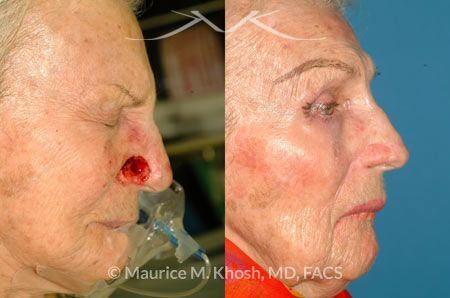
Case Study
This 76 year old lady requested consultation for nasal repair in Manhattan. She had removal of a Basal Cell Cancer from her nose which resulted in the loss of the majority of her nostril rim. A two stages naso-labial flap was used to restore her nostril.
- Patient: 76 year old female candidate for nose repair after cancer removal
- Problem: 0.5 x 0.75 inch defect of the nostril rim
- Procedure: Naso-labial flap repair of the nose
Disclaimer: These are actual results for patients of Dr. Maurice Khosh. Plastic and cosmetic surgery results can vary between patients.
Frequently Asked Questions
-
Small skin cancer defects are easily repaired under local anesthesia during an office procedure. Larger skin defects on the face, which require complicated flaps, require sedation or general anesthesia.
-
A full thickness skin graft implies the harvest of all layers of skin. During a partial thickness graft harvest, skin is only removed at the depth of papillary dermis while leaving the deeper dermis intact. Partial thickness skin graft harvest sites can regenerate the skin that was removed. Full thickness harvest sites need to be reconstructed, as the skin cannot regenerate. Full thickness skin grafts usually provide a better aesthetic result.
-
Skin grafts are pieces of skin that have been completely detached and require growth of new blood supply to survive. Skin flaps are prices of skin that remain attached to a source of blood supply while transferred to a new site. In general, skin flaps provide a superior aesthetic result in skin reconstruction.
-
Forehead flaps are quite useful in repair of large skin cancer defects on the nose. A vertically oriented flap of skin, extending from the central brow to the hairline, is rotated down to cover the nasal defect. The blood supply at the base of the flap, at the level of the eyebrow, is left intact for two weeks. In a secondary procedure, the base of the flap is cut and the flap is completely inset.
-
Nasal defects that involve the nostril rim can be repaired with a skin flap that is harvested from the fold of skin extending form the nose to the corner of the lip. The skin and its intact blood supply are rotated to the site of defect. In certain cases, a secondary procedure is necessary for final inset of the flap.
Related Procedures
The results of Moh’s reconstruction may be enhanced with secondary procedures such as scar revision and laser skin resurfacing. Repair of cancer defects of the nose may require harvest of cartilage from ear or the nose for structural repair. In eyelid repair, lower eyelid tightening or blepharoplasty may be necessary to improve the tone of the eyelid or improve symmetry between the two sides.
Click Here to See Moh’s Skin Cancer Reconstruction Photo Gallery