Male Rhinoplasty
The nose is one of the most defining features of the male face. When it is too large or has a prominent dorsal hump, it can overpower the other features and unbalance facial proportion; when it is too small or under-projected, it can leave the face lacking the structural character that masculine facial proportion typically requires. Rhinoplasty is consistently one of the most-requested male plastic surgery procedures, but it is also one of the most technically demanding — and one of the procedures most commonly requiring revision when performed without sufficient anatomical understanding. The nose is not only an aesthetic feature; it must also function correctly for normal breathing, sinus drainage, and protection of the internal nasal structures.
Male rhinoplasty follows different aesthetic rules than female rhinoplasty — straighter dorsal lines, less defined tip refinement, and preservation of the strong, angular character that defines masculine nasal proportion. Dr. Maurice Khosh’s published research on nasal anatomy and function spans three decades. Author of “Surgical Management of Nasal Valve Obstruction” in the Archives of Facial Plastic Surgery and “Unilateral Nasal Obstruction” in Greenwich Medical Publications, Dr. Khosh is dual board-certified by the American Board of Facial Plastic and Reconstructive Surgery and the American Board of Otolaryngology–Head and Neck Surgery. A Fellow of the American College of Surgeons (FACS), he has been recognized as a perennial Castle Connolly Top Doctor and a Best Doctors in America honoree.
How Male Rhinoplasty Differs from Female Rhinoplasty
The aesthetic goals of male and female rhinoplasty are significantly different — and the surgical plan must reflect those differences:
- Straighter Dorsal Profile: Male noses typically maintain a straight or slightly straight dorsal line; the gentle concavity sometimes desired in female rhinoplasty would appear feminizing on a male patient
- Less Refined Tip: Male tip refinement aims for definition without the delicacy or upturned rotation often desired in female rhinoplasty
- Preserved Dorsal Width: The masculine nose generally retains more dorsal width than the female nose; over-narrowing produces a feminizing result
- Stronger Tip Projection: Male tip projection is typically maintained or modestly increased rather than reduced
- Different Tip-to-Lip Angle: The angle between the upper lip and the nasal tip (the nasolabial angle) is typically 90 to 95 degrees in male patients vs. 100 to 105 degrees in female patients
- Conservative Hump Reduction: Removing too much of the dorsal hump can leave a male patient with a feminized nose; refinement rather than elimination is often the goal
What Male Rhinoplasty Surgery Can Address
A successful male rhinoplasty can address several distinct concerns:
- Dorsal Hump: A visible bump along the bridge of the nose, often inherited and one of the most common reasons male patients seek rhinoplasty
- Wide or Boxy Nasal Tip: A tip that lacks definition or appears disproportionately wide for the rest of the nose
- Crooked or Deviated Nose: Asymmetry of the nasal bones or septum, often from prior trauma
- Disproportionately Large or Small Nose: A nose that is out of proportion with the rest of the patient’s facial structure
- Functional Breathing Problems: Nasal valve obstruction, septal deviation, or other internal anatomy issues that interfere with breathing
- Revision of Prior Rhinoplasty: Correcting an unsatisfactory result from a previous rhinoplasty — one of the most challenging categories of nasal surgery
“Male rhinoplasty is one of the procedures where restraint produces the best results. Patients often arrive thinking the goal is to take away as much as possible — the hump, the width, the tip definition — but in male patients particularly, removing too much produces an unnatural, feminized appearance. The most satisfying outcomes come from refining the proportions while preserving the masculine character of the patient’s own nose.” — Dr. Maurice Khosh
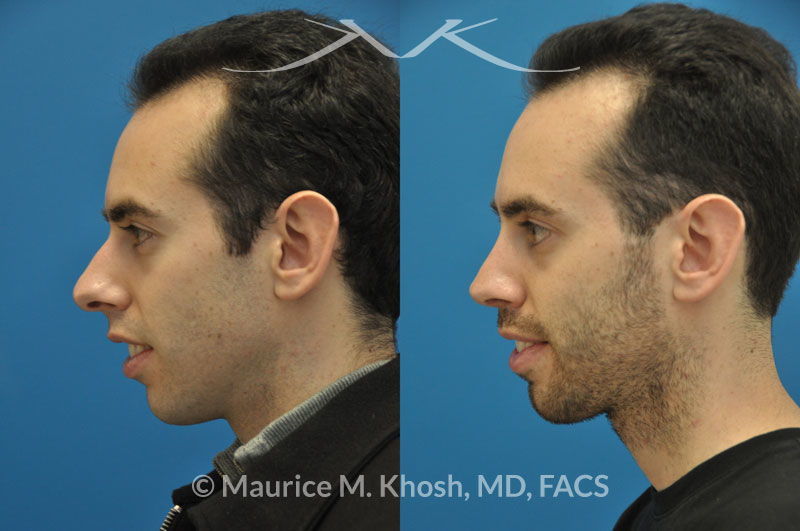
Case Study
- Patient: 27 year old man who was interested in rhinoplasty in New York
- Problem: Nasal hump, wide and poorly defined nasal tip
- Procedure: Rhinoplasty through an open approach
Disclaimer: These are actual results for patients of Dr. Maurice Khosh. Plastic and cosmetic surgery results can vary between patients.
The Open vs. Closed Rhinoplasty Approach
Two surgical approaches exist for performing rhinoplasty, each with specific advantages:
- Open Rhinoplasty: A small incision is made on the columella (the strip of tissue between the nostrils), allowing the surgeon to lift the nasal skin and visualize the underlying cartilage and bone structure directly; provides the most precise visualization for complex reshaping and is often preferred for tip work, complex deformities, and revisions
- Closed Rhinoplasty: All incisions are made inside the nostrils, leaving no external scarring; appropriate for more limited procedures and patients with specific anatomy
- Choice Depends on Anatomy and Goals: Dr. Khosh recommends the approach most appropriate for each patient based on the specific changes needed and the patient’s individual nasal anatomy
Functional and Aesthetic Considerations in Male Rhinoplasty
A successful rhinoplasty addresses both how the nose looks and how it functions. Many patients seek cosmetic rhinoplasty without realizing that pre-existing breathing problems will not improve — and may worsen — if the functional anatomy is not properly addressed. Dr. Khosh’s published research focuses specifically on nasal valve function and unilateral nasal obstruction, which means functional considerations are part of every rhinoplasty evaluation:
- Nasal Valve Assessment: Internal and external nasal valve function evaluated before surgery
- Septal Evaluation: Septoplasty performed concurrently with cosmetic rhinoplasty when indicated, often without additional recovery time
- Turbinate Management: Inferior turbinate reduction performed when nasal obstruction warrants
- Functional-Aesthetic Integration: Surgical plan designed to optimize both function and appearance simultaneously rather than treating them as separate goals
Male Rhinoplasty Recovery: What to Expect
Male rhinoplasty is typically performed under general anesthesia at an accredited surgical facility. The procedure usually takes two to three hours. Patients return home the same day with a small external splint protecting the nose for the first week. Bruising and swelling are most pronounced during the first one to two weeks; the splint is removed at one week, and most patients return to work and non-physical activities at this point. Significant swelling continues to gradually resolve over the following several months, and the final result becomes fully visible at approximately twelve to eighteen months after the procedure.
Why Choose Dr. Khosh for Male Rhinoplasty
- Published Nasal Authority: Author of peer-reviewed research on nasal valve obstruction and unilateral nasal obstruction
- Three Decades of Rhinoplasty Experience: Refined understanding of how male and female rhinoplasty differ
- Functional and Aesthetic Integration: Surgical plan addresses both how the nose looks and how it functions
- Both Open and Closed Approach: Technique matched to the specific surgical needs of each patient
- Revision Rhinoplasty Capability: Experience correcting unsatisfactory results from prior rhinoplasty
- Dual Board Certification: Combined facial plastic and head and neck surgery expertise
- Park Avenue Convenience: Private Upper East Side practice serving patients from across Manhattan and the tri-state area
Schedule Your Male Rhinoplasty Consultation in NYC
If you are ready to refine the appearance of your nose while preserving the masculine character of your face, the first step is a thorough evaluation of your nasal anatomy — both internal and external — and a careful discussion of realistic surgical goals. Contact the office of Dr. Khosh today for your private consultation at his Park Avenue office in New York City, or call (212) 339-9988.

Click Here to See Rhinoplasty Photo Gallery