New York Facial Skin Laceration Repair
The facial skin is among the thinnest and most delicate on the body, and it scars more readily and more visibly than skin anywhere else. When a cut or laceration occurs to the face — from an accident, sports injury, fall, or other trauma — the immediate response is usually a trip to the nearest emergency room. While emergency room physicians are excellent at the urgent work of stopping bleeding and closing wounds, scar minimization is rarely their primary concern. The result of a fast, functional ER repair can be a lasting facial scar that alters the patient’s appearance and produces emotional consequences far longer than the original injury. Facial skin laceration repair performed by a facial plastic surgeon focuses specifically on minimizing the visible aftermath — closing the wound in a way that allows the skin to heal with as little permanent change as possible. Facial skin laceration repair is one of the procedures within facial reconstruction at Dr. Khosh’s Park Avenue practice in New York City.
Most facial scars are not the result of the original injury — they are the result of the repair. Dr. Maurice Khosh’s published expertise on scar treatment directly informs every laceration repair he performs. Author of “Surgical Treatment of Facial Scars” — a published chapter through Thieme Publishers — he brings the technique calibrated specifically for minimizing the visible aftermath of facial wounds. Dual board-certified by the American Board of Facial Plastic and Reconstructive Surgery and the American Board of Otolaryngology–Head and Neck Surgery, Dr. Khosh is a Fellow of the American College of Surgeons (FACS) and has been recognized as a perennial Castle Connolly Top Doctor.
Why a Facial Plastic Surgeon Matters for Laceration Repair
The difference between a facial plastic surgeon repair and a general emergency room repair comes down to several specific technical details:
- Incision Orientation Along Natural Skin Tension Lines: The direction of the closure relative to the skin’s natural tension lines significantly affects how visible the eventual scar will be
- Layered Closure Technique: Proper closure involves multiple layers of suture — not just the surface skin — to relieve tension on the visible layer and allow the underlying tissue to heal cleanly
- Fine, Tissue-Specific Sutures: The size and material of the sutures used affect scar quality; facial skin requires the finest available
- Debridement and Wound Edge Preparation: Carefully refreshing the wound edges before closure can significantly improve the final scar appearance
- Knowledge of Anatomical Landmarks: Repairing structures near critical landmarks — the lip border, eyelid margin, nostril rim, brow line — requires precise alignment that may not be a priority in emergency settings
“The job of the emergency room is to close the wound and stop the bleeding — and they do that work well. The job of a facial plastic surgeon is to close the wound in a way that the patient won’t notice it five years from now. Those are two different priorities, and they sometimes require very different technique. The first repair is the easiest opportunity to minimize what would otherwise become a lifelong scar.” — Dr. Maurice Khosh
Emergency Skin Laceration Repair: The 24-Hour Window
The first response when a facial laceration or cut occurs is to assess whether the situation is life-threatening — and if it is, to go to an emergency room immediately. If the cut is not life-threatening or can be temporarily managed at home, emergency facial laceration repair can be scheduled directly with Dr. Khosh’s office. In most cases, this should occur within 24 hours of the injury for the best aesthetic results. It is far easier for Dr. Khosh to minimize visible scarring through a primary repair than to attempt to revise a quick emergency room closure later. If it is necessary to have an emergency repair performed at the hospital, contact Dr. Khosh’s office as soon as possible after the accident to schedule a consultation, so any potential revision work can be planned promptly.
Case Study
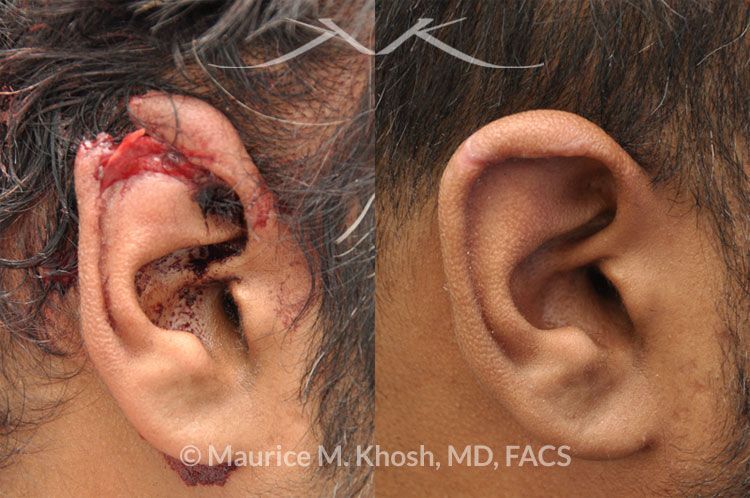
31 year old man requested rsuffered a laceration to his right upper ear (auricle). This skin injury resulted in exposure of the ear cartilage and a through and through laceration that involved the front and the back of his ear. Complex repair of this laceration was performed on emergency basis in the office, under local anesthesia.
- Patient: 31 year old man with laceration cut injury to his ear in New York
- Problem: Complex laceration of the upper ear with exposed cartilage
- Procedure: Complex repair of torn ear
Disclaimer: These are actual results for patients of Dr. Maurice Khosh. Plastic and cosmetic surgery results can vary between patients.
Why Patients Choose Dr. Khosh for Facial Skin Laceration Repair
- Published Scar Treatment Authority: Author of “Surgical Treatment of Facial Scars” through Thieme Publishers
- Office-Based Emergency Capability: Many lacerations can be repaired the same day under local anesthesia in Dr. Khosh’s Park Avenue office
- Layered, Cosmetic-Grade Closure Technique: Scar-minimization technique calibrated specifically to facial skin
- Dual Board Certification: Combined facial plastic and head and neck surgery expertise
- Park Avenue Convenience: Private Upper East Side practice serving patients from across Manhattan and the tri-state area
Schedule an Emergency Consultation in Manhattan
If you or your child has sustained a facial laceration, prompt evaluation by a facial plastic surgeon can significantly affect the final aesthetic outcome. Contact our office today to schedule an emergency facial skin laceration repair, or call (212) 339-9988 directly. Dr. Khosh and his team will do their best to accommodate emergency situations into the schedule.
Click Here to See Skin Laceration Repair Photo Gallery