Facial Fat Grafting or Fat Transfer
Facial fat grafting — also known as fat transfer or facial liposculpture — is one of the most natural and longest-lasting options for restoring lost facial volume. As we age, the face loses subcutaneous fat in specific compartments, leading to hollow cheeks, deeper folds, sunken temples, and a less youthful overall contour. By harvesting a small amount of the patient’s own fat from the lower body and meticulously re-injecting it into targeted areas of the face, fat grafting can restore balance and softness using tissue the body recognizes as its own. The results integrate naturally into the surrounding anatomy, do not carry the risk of allergic reaction, and — unlike most injectable fillers — can last for years.
Dr. Maurice Khosh performs facial fat grafting at his Park Avenue practice in New York City. Dual board-certified by the American Board of Facial Plastic and Reconstructive Surgery and the American Board of Otolaryngology–Head and Neck Surgery, Dr. Khosh is a Fellow of the American College of Surgeons (FACS) and a Clinical Assistant Professor at Columbia University. Fat grafting sits at the intersection of small surgical procedure (the harvest) and precision injection (the placement) — meaning the technique demands both the dexterity of a facial surgeon and the trained aesthetic eye of an artist. A lifelong student of figure drawing and calligraphy, Dr. Khosh brings three decades of facial surgical experience and a deep familiarity with the underlying fat compartments of the face to every transfer he performs. He is a perennial Castle Connolly Top Doctor and recipient of the Best Doctors in America designation.
How Facial Fat Grafting Works
A small amount of fat is gently harvested from the patient’s lower body — typically the abdomen, flank, or thigh — through a minor liposuction step performed under local anesthetic. The harvested fat is then carefully prepared and meticulously injected into designated areas of the face using fine cannulas designed to place small aliquots of fat at the correct anatomical depth. The injected cells gradually establish their own blood supply over the weeks following the procedure; the percentage that “takes” becomes the permanent volume restoration the patient sees long term.
“Fat transfer is as much about restraint and proportion as it is about volume. A small amount placed in exactly the right plane can restore years of facial balance — the same amount placed without that precision can look unnatural. The art is in knowing where each cell will settle and how the face will look six months from now.” — Dr. Maurice Khosh
Areas Commonly Treated with Fat Transfer
Fat grafting can be used throughout the face to address localized volume loss and restore youthful proportions. The most commonly treated areas include:
- Cheeks: Restores midface fullness and elevates the cheekbone contour
- Tear Troughs and Orbital Area: Smooths the transition between the lower lid and cheek, softening shadowing
- Temples: Refills the hollowing that develops along the side of the forehead with age
- Brow Area: Restores subtle support beneath the eyebrow for a refreshed, less tired appearance
- Nasolabial Folds and Marionette Lines: Softens the deep folds between the nose, mouth, and chin
Schedule Your Consultation in Manhattan
Facial fat grafting offers one of the most natural and durable approaches to restoring lost volume — but the result depends on accurate evaluation of where the face needs volume, careful harvest technique, and precise placement at the right anatomical depth. To learn more about facial fat grafting, fat transfer, or facial liposculpture in New York City, or to schedule a consultation with Dr. Khosh at his Park Avenue office, call (212) 339-9988 or contact us online to request an appointment.
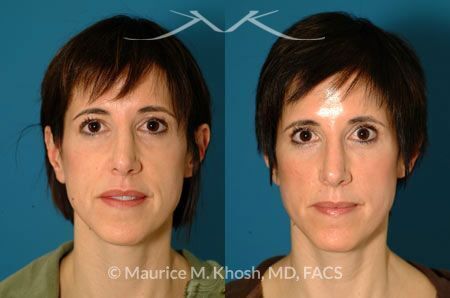
Case Study
This 46 year old patient requested consultation for facial rejuvenation. She wanted natural appearing enhancement of her face. I recommended upper blepharoplasty and fat transfer. She underwent fat transfer from the abdominal area to the upper and mid face.
- Patient: 46 year old female fat transfer candidate
- Problem: Aged appearance of the face
- Procedure: Fat transfer, Upper blepharoplasty
Disclaimer: These are actual results for patients of Dr. Maurice Khosh. Plastic and cosmetic surgery results can vary between patients.
Frequently Asked Questions
-
The volume of fat transfer is dependent on the needs of each patient. On an average patient, 10 to 15 ml of fat is transferred during one session.
-
In order for the transferred fat cells to remain viable, the liposuction needs to be performed with a delicate low suction technique. The standard body liposuction is performed under high suction with possible addition of ultrasound or laser, both of which are disruptive to the fat cells. One option would be to harvest the fat transfer cells before the standard liposuction during one procedure.
-
Yes, but not necessarily due to the transferred fat cells. The face always becomes fuller with weight gain and this process will not be significantly affected after fat transfer.
-
Fat cells can be harvested from the abdominal area, the flank area, the outer thigh or the inner thigh. The incisions are only 3 millimeters and do not leave a visible scar.
-
Most patients reach their desired results with only one session of fat grafting. In some patients, a second procedure may be necessary.
-
The donor area may be sore or slightly bruised for one week. The face is swollen for less than a week. There is minimal discomfort and patients typically return to work and social activities within one week.
-
No. Most our patients undergo the procedure under local anesthesia. Occasionally sedation is used to relax a very nervous patient.
Related Procedures
Fat transfer is a rejuvenation procedure for the face. Other facial rejuvenation procedures can add to the effects of fat transfer include: minor office procedures such as Botox injections or laser skin resurfacing with fractional lasers, small surgical procedures such as blepharoplasty or neck liposuction, and larger surgical treatments such as face lift, brow lift, or neck lift.