Earlobe Repair
A torn, stretched, or split earlobe can be a surprisingly bothersome cosmetic concern — earrings no longer sit correctly, the lobe shape looks elongated or asymmetric, and the original damage often becomes more visible over time. Most earlobe damage comes from piercings: a heavy earring gradually stretches a piercing hole over years, an earring is caught on clothing or pulled, or an intentional ear stretching (gauging) is later regretted. Other patients seek earlobe repair after aging-related elongation, congenital cleft, or simply wanting to close multiple old piercing holes. Whatever the cause, earlobe repair is a precise in-office procedure that restores the natural lobe shape with a virtually invisible result. Earlobe repair is one of the ear procedures Dr. Khosh performs at his Park Avenue practice in New York City.
Earlobe repair sounds simple, but a natural-looking outcome requires meticulous tissue handling and the kind of fine technique that defines facial plastic surgery. Dr. Maurice Khosh brings exactly that. Dual board-certified by the American Board of Facial Plastic and Reconstructive Surgery and the American Board of Otolaryngology–Head and Neck Surgery, Dr. Khosh is a Fellow of the American College of Surgeons (FACS) and the former Director of Facial Plastic Surgery Clinics at Columbia University Medical Center and St. Luke’s-Roosevelt Medical Center. He has served on the American Academy of Facial Plastic and Reconstructive Surgery’s Board Examination and Continuing Education Committees, contributing to the national standards of practice in his field. With three decades of operating on the delicate tissue of the face and ears, Dr. Khosh has been recognized as a perennial Castle Connolly Top Doctor, a Best Doctors in America honoree, and a Super Doctors New York Rising Star. The same precision he brings to complex reconstructive cases is the precision a small earlobe repair benefits from.
What Earlobe Repair Can Address
Dr. Khosh performs earlobe repair for a wide range of concerns affecting the lower portion of the ear:
- Torn or Split Earlobes: A piercing that has torn completely through the bottom of the lobe, often from a snagged earring or accident
- Stretched Piercings: Piercings that have gradually enlarged over the years from heavy earrings, leaving an oversized or oval-shaped hole
- Gauged or Tunneled Earlobes: Previously stretched piercings — sometimes to significant diameters — that the patient now wants closed
- Elongated Earlobes: Aging-related lobe elongation, often accompanied by thinning of the lobe tissue
- Congenital Cleft Earlobes: A natural split or notch in the earlobe present from birth
- Multiple Old Piercing Holes: Several closed-but-visible piercing holes the patient would like surgically closed for a clean look
- Asymmetric Earlobes: Differences in size or shape between the two lobes
What to Expect from the Procedure
Earlobe repair is one of the most comfortable procedures in facial plastic surgery. Most repairs are performed under local anesthesia in Dr. Khosh’s Park Avenue office and take 30 to 45 minutes. After numbing the area, Dr. Khosh carefully removes the damaged or stretched tissue and closes the wound with fine sutures designed to produce a virtually invisible scar. The earlobe is reshaped at the same time to restore the natural contour. Patients return home immediately afterward, and most resume work and normal activities the same day or the next day. Stitches are typically removed seven to ten days after the procedure.
“Earlobe repair is one of those procedures where small refinements in technique make a visible difference. The way the tissue is trimmed, the suture placement, and the reshaping of the lobe itself all influence whether the result looks repaired or looks like it was always that way. The goal is the latter.” — Dr. Maurice Khosh
Can the Earlobe Be Re-Pierced After Repair?
Yes — many patients want to wear earrings again after their earlobe is repaired. Dr. Khosh typically recommends waiting at least six weeks after the procedure before re-piercing the ear, to allow the tissue to fully heal and the scar to mature. When the lobe is re-pierced, the new piercing is placed in a slightly different location than the original to avoid stressing the repaired tissue. Patients with a history of significant stretching or repeated tearing may wish to consider pierceless earring options instead.
Why Patients Choose Dr. Khosh for Earlobe Repair
- Fine Surgical Technique: Three decades of delicate facial tissue work refined into the kind of precision invisible-scar repair requires
- Dual Board Certification: Procedure performed by a dual board-certified facial plastic and head and neck surgeon
- Office-Based Convenience: Local anesthesia, no operating room required, same-day return to activities
- Honest Re-Piercing Guidance: Realistic conversation about timing, location, and earring choices to protect the repair
- Park Avenue Convenience: Private Upper East Side practice serving patients from across Manhattan and the tri-state area
Schedule Your Consultation in Manhattan
Whether your earlobe concern is a recently torn piercing, a years-stretched hole, a gauged earlobe you would like closed, or simply lobe elongation that has developed with age, the right outcome depends on careful evaluation and fine surgical technique. To schedule a consultation with Dr. Khosh at his Park Avenue office in New York City, call (212) 339-9988 or contact us online to request an appointment.
Case Study
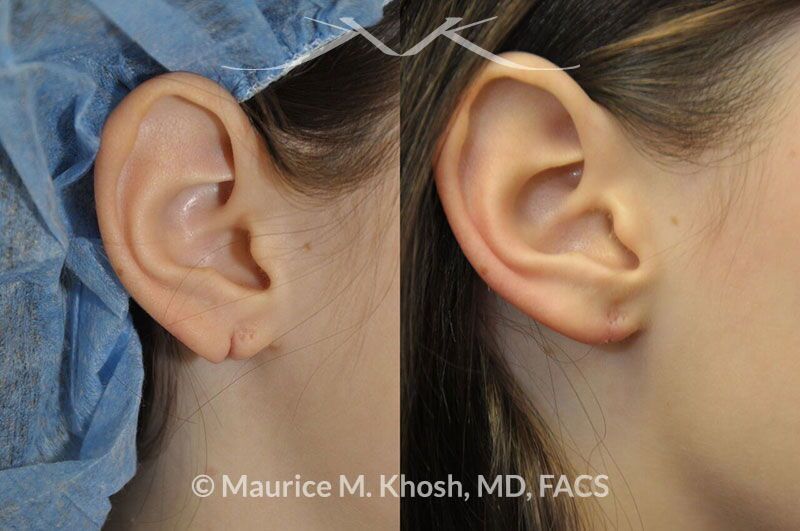
This 18 year old has suffered a torn right earlobe. The picture on the left side depicts the outcome of the repair after one week, following suture removal.
Disclaimer: These are actual results for patients of Dr. Maurice Khosh. Plastic and cosmetic surgery results can vary between patients.
Click Here to See Torn Earlobe Repair Photo Gallery