Twisted Nose Correction in NYC
A twisted nose is one of the more three-dimensionally complex nasal deformities. Unlike a simple lateral deviation, a twisted nose involves rotation or angulation of the nasal structures in multiple planes — and the twist can occur at the upper bony portion of the nose, the middle cartilaginous portion, the nasal tip, or any combination of all three. When the twist involves the tip specifically, it commonly produces asymmetric nostrils of different shapes and frequently causes functional breathing obstruction in addition to the visible deformity. Twisted noses are most often caused by previous nasal trauma — sometimes a single significant injury, sometimes the cumulative effect of multiple smaller incidents — and less commonly result from congenital developmental variation. The visible deformity of a twisted nose can be significantly distracting, pulling attention away from other facial features and affecting overall facial symmetry. Twisted nose correction is one of the procedures within rhinoplasty and nose reshaping at Dr. Khosh’s Park Avenue practice in New York City.
The twisted nose is fundamentally a three-dimensional problem — the twist can occur at the upper bony nose, the middle cartilaginous nose, the tip, or any combination of all three — and effective correction requires addressing each level of the deformity that is involved. Dr. Maurice Khosh’s three decades of complex rhinoplasty experience cover the full range of techniques required, including osteotomies for bony rotation, spreader grafts for middle vault asymmetry, and tip reconstruction for twisted tip cartilages. Dual board-certified by the American Board of Facial Plastic and Reconstructive Surgery and the American Board of Otolaryngology–Head and Neck Surgery and the former Director of Facial Plastic Surgery Clinics at Columbia University Medical Center, Dr. Khosh is a Fellow of the American College of Surgeons (FACS). He has been recognized as a perennial Castle Connolly Top Doctor and a New York Magazine Best Doctor in Facial Plastic Surgery.
What Causes a Twisted Nose
Several mechanisms can produce a twisted nasal deformity:
- Single Significant Trauma: A direct blow to the nose from a sports injury, fall, car accident, or physical altercation that fractured the bones or cartilage and healed in a rotated position
- Untreated Childhood Injury: A nasal injury during childhood that was never evaluated; the developing nose continues to grow in a twisted configuration as the underlying structures mature
- Cumulative Minor Trauma: Multiple smaller nasal injuries over years (common in athletes) that each contributed incremental rotation
- Septal Deviation: A significantly deviated nasal septum can pull the external nasal structures into a rotated position
- Genetic/Developmental Variation: Less commonly, congenital asymmetric development of the nasal structures during growth
- Previous Surgery: A twisted appearance that emerged or worsened after prior rhinoplasty when underlying asymmetries were not adequately corrected
The Three Anatomical Levels of Nasal Twist
Identifying which level (or levels) of the nose is twisted is the most important step in surgical planning. Each level requires different correction techniques:
- Upper Bony Nose Twist: The nasal bones (the bony upper third of the nose) are rotated to one side; correction requires controlled bone cuts (osteotomies) and repositioning
- Middle Cartilaginous Nose Twist: The upper lateral cartilages and septum (the middle third of the nose) are rotated; correction typically requires spreader grafts and septal straightening
- Twisted Tip: The lower lateral cartilages forming the nasal tip are rotated, producing asymmetric nostrils of different shapes; correction requires cartilage reconstruction using grafts
- Combined Multi-Level Twist: Many twisted noses involve more than one level — and effective correction requires addressing all of the affected levels rather than only one
Non-Surgical Twisted Nose Correction with Dermal Filler
For patients with a mildly twisted nose, non-surgical correction using dermal filler can produce a visible improvement without surgery. Filler products such as Restylane and Juvederm can be carefully placed into the concave areas of the twist to create the appearance of a straighter, more symmetric nose. The technique works by visually filling in the depressed side of the rotation, allowing the eye to perceive symmetry where the underlying anatomy is still rotated.
Important limitations to understand:
- Effective Only for Mild Twist: Moderate to severely twisted noses require surgical correction; filler cannot adequately compensate for significant rotation
- Cannot Address Breathing: Filler can only improve appearance; any associated breathing obstruction from the twist requires surgical treatment
- Temporary Result: Filler effect lasts 12 to 18 months and must be maintained
- Does Not Address Underlying Structure: The bones, cartilage, and septum remain in their rotated position; filler creates only a visual correction
Surgical Correction for a Mildly Twisted Nose
For mild twists, surgical correction can be performed through either closed or open rhinoplasty depending on the specific anatomical structures involved. The procedure may include several distinct techniques:
- Cartilage Camouflage Grafting: Strategically placed cartilage grafts to camouflage the twist visually and create the appearance of a symmetric nose
- Tip Cartilage Reconstruction: If the tip is the primary location of the twist, the tip cartilages may be deconstructed and reconstructed using cartilage grafts to rebuild a straight, symmetric tip
- Osteotomy for Bony Twist: When the twist is due to the nasal bones being rotated to one direction, controlled bone cuts (osteotomy) allow asymmetric repositioning to move the bones into a straighter configuration
- Septal Straightening: Correction of any underlying septal deviation contributing to the external twist
Surgical Correction for Moderate to Severely Twisted Nose
For moderate to severe twisted noses, an open approach rhinoplasty is necessary to permanently reshape the nose through direct visualization of the internal anatomy. The procedure typically requires a coordinated combination of techniques:
- Bilateral Osteotomy: Cutting and asymmetric repositioning of the nasal bones to straighten the upper bridge of the nose
- Spreader Grafts: Cartilage strips sourced from the septum, ear, or rib placed in the middle vault to add width and structural support, also helping to maintain straightness after the underlying rotation is corrected
- Tip Cartilage Reconstruction: The nasal tip cartilages may need to be replaced or augmented with cartilage grafts to alter the shape and configuration of a twisted tip
- Septal Reconstruction: For patients with significant septal deviation contributing to the external twist, septal reconstruction (septoplasty or extracorporeal septal work) becomes essential
- Coordinated Multi-Level Correction: Each level of the twist is addressed in a coordinated way during the same surgical session
“Correcting a twisted nose is one of the most demanding rhinoplasty procedures because the deformity exists in three dimensions and often involves three anatomical levels. Addressing only one level — say, the bone — while leaving the cartilage and tip rotated produces an incomplete and often disappointing result. The diagnosis is most of the surgical plan: identifying exactly which levels are involved, in which directions, and in what severity determines whether the correction will hold or relapse.” — Dr. Maurice Khosh
Twisted Nose Surgery Recovery
Surgical correction of a twisted nose is typically performed under general anesthesia at an accredited surgical facility. The procedure usually takes two to four hours depending on which levels of the twist are being corrected and whether cartilage grafting from a donor site (ear or rib) is required. Patients return home the same day with a small external splint protecting the nose for the first week. Bruising and swelling are most pronounced during the first one to two weeks; the splint is removed at one week, and most patients return to non-physical work at this point. Because of the complexity of multi-level correction and the cartilage grafting involved, the final result takes longer than primary rhinoplasty to fully emerge — typically twelve to eighteen months after surgery as the cartilage grafts integrate and residual swelling resolves.
Why Choose Dr. Khosh for Twisted Nose Correction
- Three Decades of Complex Rhinoplasty Experience: Refined understanding of multi-level twist correction across thousands of procedures
- Former Director of Columbia University Facial Plastic Surgery Clinics: Academic leadership credential reflecting expertise across the spectrum of facial plastic surgery
- Full Range of Techniques: Osteotomy, spreader grafts, cartilage camouflage, tip reconstruction, and septal correction all available
- Both Non-Surgical and Surgical Options: Honest recommendation of the right approach for each patient’s specific degree of twist
- Functional and Aesthetic Integration: Surgical plan addresses both the visible twist and any associated breathing impairment
- Dual Board Certification: Combined facial plastic and head and neck surgery expertise
- Park Avenue Convenience: Private Upper East Side practice serving patients from across Manhattan and the tri-state area
Schedule Your Twisted Nose Consultation in NYC
If you are dealing with a twisted nose — whether from a previous injury, congenital asymmetry, or unsatisfactory previous surgery — the first step is a thorough evaluation of which anatomical levels are involved and a realistic discussion of what corrective surgery can achieve. To schedule a private consultation with Dr. Khosh at his Park Avenue office in New York City, contact us today, or call (212) 339-9988.
Other Concerns About Your Nose

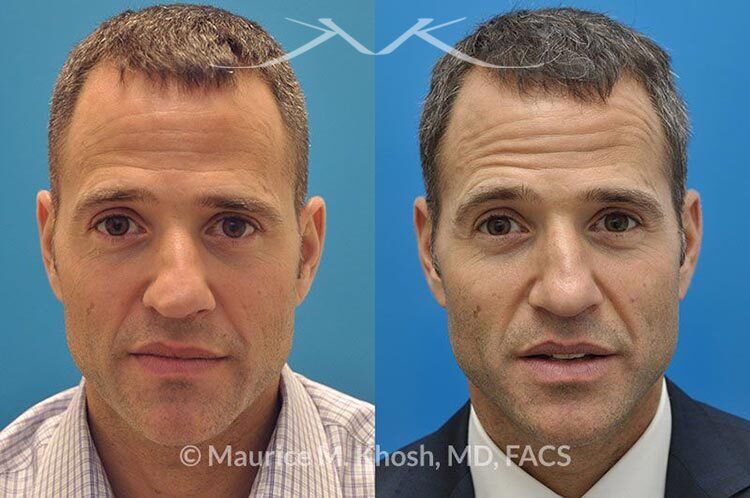
Click Here to See Broken Nose Repair, Facial Fracture Repair Photo Gallery