Ethnic Rhinoplasty
The goal of any rhinoplasty or nose job surgery is creating a nose that functions well, looks like a natural feature of the face, and is in harmony with the patient’s other facial proportions. For patients of every ethnic background, the surgeon’s understanding of how ethnic anatomy affects the surgical plan is essential. Factors that vary across ethnic groups include skin quality and thickness, cartilage resilience and shape, nostril width and position, dorsal bridge height, tip projection, and the overall framework of the underlying bone — all of which influence both what is surgically possible and what produces an aesthetically successful result for each patient.
There is no single ideal nose. Every face is its own composition, and the rhinoplasty that suits one patient may look entirely wrong on another — particularly when ethnic anatomy and the patient’s individual proportions are not accounted for in the surgical plan. Dr. Maurice Khosh’s three decades of rhinoplasty work include extensive experience with patients across the full range of ethnic backgrounds — African American, Hispanic, Asian, Middle Eastern, South Asian, Mediterranean, Caucasian, and the many anatomical variations within each. A Clinical Assistant Professor at Columbia University and dual board-certified by the American Board of Facial Plastic and Reconstructive Surgery and the American Board of Otolaryngology–Head and Neck Surgery, Dr. Khosh is a Fellow of the American College of Surgeons (FACS). He has been recognized as a perennial Castle Connolly Top Doctor and a Best Doctors in America honoree.

What Makes Ethnic Rhinoplasty Different
Ethnic rhinoplasty is not a separate technical category of rhinoplasty — it is rhinoplasty performed with specific attention to the anatomical variations and aesthetic goals that ethnicity brings to the procedure:
- Anatomical Variation: Underlying nasal structures vary significantly across ethnic groups, requiring different surgical techniques and different approaches to cartilage management
- Direction of Change: Some ethnic groups more commonly seek reduction (Mediterranean, some Caucasian patterns); others more commonly seek augmentation (Asian, African American, some Hispanic patterns)
- Skin Characteristics: Thickness, sebaceous quality, healing patterns, and risk of certain healing complications (such as keloid scarring) vary across ethnic groups
- Identity Preservation: A central principle of modern ethnic rhinoplasty is preserving the patient’s ethnic and family features rather than imposing a single “ideal” aesthetic
- Cultural Sensitivity: The consultation conversation requires cultural awareness about what features are valued and what features the patient wants refined
- Family Reference: Many patients want to maintain visible resemblance to family members while addressing specific concerns
Anatomical Considerations Across Ethnic Backgrounds
While every patient is evaluated individually rather than according to broad ethnic categories, several general anatomical patterns inform surgical planning:
- African American Anatomy: Often features a lower nasal bridge, wider alar base, softer tip cartilages, and thicker skin — with higher rates of hypertrophic scar and keloid formation requiring careful incision planning
- Asian Anatomy (with significant variation across East, Southeast, South, and Central Asian backgrounds): Often features a lower bridge, less projecting tip, thicker skin, and less septal cartilage available for grafting
- Hispanic Anatomy (with substantial regional variation): Often features moderate skin thickness with significant variation in bridge height, tip projection, and nostril width across South American, Mexican, Caribbean, and Central American patterns
- Middle Eastern Anatomy: Often features a higher bridge with dorsal hump, drooping or longer tip, and thicker skin with sebaceous quality
- South Asian Anatomy: Often features moderate bridge height with significant variation in tip refinement and skin thickness
- Mediterranean Anatomy: Often features more prominent dorsal humps and longer noses, with patient goals frequently focused on reduction
- Caucasian Anatomy (with extensive variation across European backgrounds): Generally features thinner skin and more reductive surgical approaches
Within any of these categories, individual patient anatomy varies tremendously — the surgical plan is always based on the specific patient, not on broad generalization.
Preserving Ethnic Identity in Rhinoplasty
One of the most important conversations in ethnic rhinoplasty is about what to refine and what to preserve. Modern ethnic rhinoplasty has moved significantly away from earlier approaches that tried to standardize all noses toward a single aesthetic:
- Identity-Preserving Approach: The surgical goal is improving specific features the patient wants addressed, while preserving the underlying character that defines the patient’s individual face and family resemblance
- Patient-Defined Aesthetics: Each patient defines what they want — the surgeon’s role is to deliver that specific result with technical excellence and honest evaluation
- Family Resemblance Preserved: Patients should still recognize themselves and their family in their face after surgery
- Honest Communication: Realistic conversation about what rhinoplasty can and cannot accomplish for a particular patient’s anatomy
- Cultural Awareness: Surgeon-patient dialogue informed by understanding of what features are valued within the patient’s cultural and family context
Goals of Ethnic Rhinoplasty
While each patient brings individual goals, several outcomes are common across ethnic rhinoplasty:
- Balanced Facial Proportion: A nose that fits the patient’s specific facial structure rather than one that looks transplanted from a different anatomy
- Functional Preservation or Improvement: Maintaining or improving breathing function while addressing aesthetic concerns
- Long-Term Stable Results: Surgical changes that hold over years and look natural as the patient ages
- Cultural Identity Retention: A nose that still looks like the patient’s own — refined, but recognizable
- Specific Concern Resolution: Addressing the specific issues the patient brought to the consultation (bridge height, tip refinement, nostril width, asymmetry, breathing) without imposing additional changes
“The most important shift in ethnic rhinoplasty over the past two decades has been the move away from a single aesthetic ideal toward truly individualized planning. Patients don’t want their face to look like someone else’s face — they want their own face, refined in the specific ways they’re concerned about. The most satisfying outcomes are the ones where the patient can look in the mirror and recognize themselves, just with the specific improvement they came in for.” — Dr. Maurice Khosh
The Ethnic Rhinoplasty Consultation
During your consultation, Dr. Khosh will take time to understand your specific concerns and your desired outcome. The conversation typically includes:
- Goals Discussion: Listening carefully to what you want addressed and what you want preserved
- Anatomical Assessment: Internal and external examination of your nose, including breathing function
- Computer Imaging: Visualizing potential surgical outcomes through computer imaging to facilitate communication about what is achievable
- Treatment Options: Discussion of surgical and (where appropriate) non-surgical options available for your specific anatomy
- Limitations and Benefits: Honest conversation about what each approach can and cannot accomplish
- Recovery Expectations: Detailed explanation of expected recovery timeline and what to expect at each phase
- Photo Gallery Review: Examples of rhinoplasty results in patients with similar ethnic backgrounds and concerns
Surgical Techniques for Ethnic Rhinoplasty
Ethnic rhinoplasty often requires more advanced surgical techniques than reductive rhinoplasty in some other patient populations:
- Cartilage Grafting: For patients requiring augmentation (bridge height, tip projection, lengthening), cartilage grafts from the septum, ear, or rib provide structural support
- Tip Refinement Techniques: Cephalic trim, dome binding sutures, columellar strut grafts, septal extension grafts, and shield grafts — used individually or in combination depending on tip anatomy and goals
- Alar Base Reduction (Weir Excision): Carefully designed wedge resection to narrow wide or flared nostrils
- Osteotomies: Controlled bone cuts to address bridge width, asymmetry, or significant dorsal hump
- Combined Approaches: Most ethnic rhinoplasty cases benefit from combinations of techniques addressing bridge, tip, and base concerns simultaneously
- Open vs. Closed Approach: Either approach can be appropriate; the open approach is often preferred for complex cases requiring extensive cartilage grafting
Why Choose Dr. Khosh for Ethnic Rhinoplasty
- Three Decades of Multi-Ethnic Rhinoplasty: Refined experience across African American, Hispanic, Asian, Middle Eastern, South Asian, Mediterranean, and Caucasian anatomies
- Identity-Preserving Approach: Surgical planning that respects the patient’s ethnic and family features rather than imposing a universal aesthetic
- Individualized Treatment Planning: Each rhinoplasty plan is tailored to the patient’s specific anatomy and goals
- Full Range of Techniques: Cartilage grafting, tip refinement, alar base reduction, osteotomies, and combination approaches all available
- Functional and Aesthetic Integration: Every plan addresses both appearance and breathing function
- Cultural Sensitivity: Care to understand each patient’s cultural context and individual goals
- Dual Board Certification: Combined facial plastic and head and neck surgery expertise
- Park Avenue Convenience: Private Upper East Side practice serving patients from across Manhattan and the tri-state area
Schedule Your Ethnic Rhinoplasty Consultation in NYC
If you are considering rhinoplasty and want a surgeon who understands how to address your specific aesthetic concerns while preserving the distinctive features of your ethnic and family anatomy, the first step is a thorough consultation evaluating your individual nasal structure and goals. Contact our practice today to schedule your consultation with Dr. Khosh at his Park Avenue office in New York City, or call (212) 339-9988.
Case Study
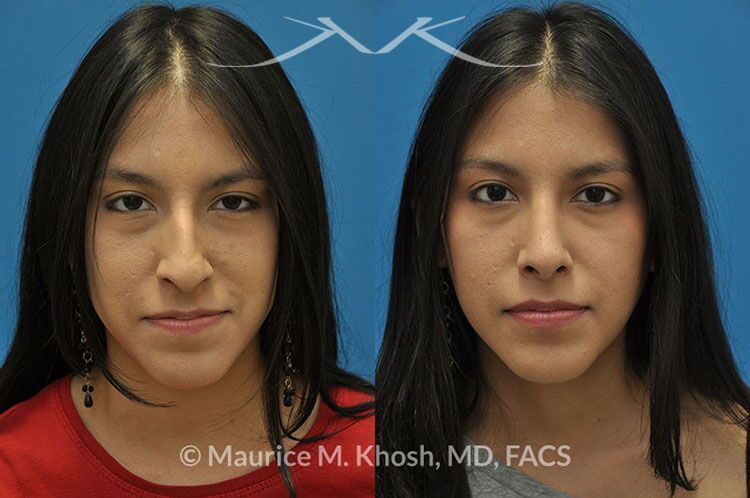
26 year old young lady with Hispanic heritage, requested rhinoplasty in Manhattan to address a nasal hump, droopy tip, and wide nostrils. An open rhinoplasty approach was used to remove the nasal hump and and to modify the tip.
- Patient: 26 year old lady who was interested in ethnic rhinoplasty in New York
- Problem: Nasal hump, droopy tip with wide nostrils
- Procedure: Open rhinoplasty to reduce the hump, elevate and refine the tip, and narrow the nostrils
Disclaimer: These are actual results for patients of Dr. Maurice Khosh. Plastic and cosmetic surgery results can vary between patients.
Frequently Asked Questions
-
Dorsal nasal augmentation is a frequently requested by Asian and Latino patients. The nose can be built up through placement of implants or grafts. Implants such as polytetrafluoroethylene (PTFE) with brand names such as Gortex and Medpore work very well. Cartilage implants from the nasal septum, ear cartilage or rib cartilage constitutes other options for augmentation materials.
-
The technical term for this procedure is increasing tip projection. In ethnic rhinoplasty this maneuver involves placement of cartilage implants in the nasal tip. Cartilage grafts in this area not only advance the tip; they can also add definition and refinement to the nasal tip.
-
Nostril narrowing is routinely done during rhinoplasty. In order for the results to be natural, incision placements need to be precise and the sutures need to be perfectly placed.
-
In rhinoplasty, the cartilage and bony framework of the nose is altered. These changes need to become visible through the skin. In thick-skinned patients, maneuvers such as cartilage grafting may be needed to add definition to the appearance of the nose. Thick skin has the advantage of allowing placement of grafts or implants without the fear of an implant outline becoming visible on the nose.
Related Procedures
Rhinoplasty is commonly performed with septoplasty (correction of a deviated septum) and turbinate (internal nasal membrane) reduction to enhance breathing. In some rhinoplasty procedures, repair of the nasal valve may also be warranted to ensure good breathing. In order to achieve balance in the face, chin augmentation may be recommended during a rhinoplasty consultation. Sinus surgery can be safely combined with rhinoplasty, in individuals with chronic sinus issues.