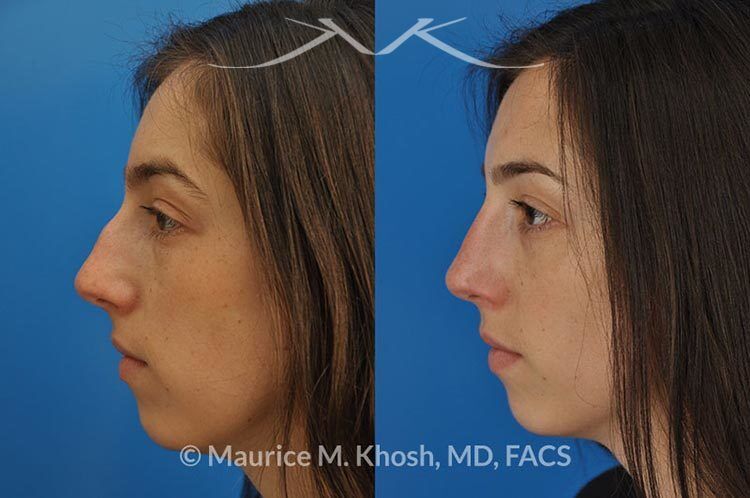
Nose Hump Reduction in NYC
A nose hump — also called a nose bump or dorsal hump — describes a raised area on the bridge of the nose that produces a visible bump along the nasal profile. Nose humps can range from small irregularities that rise and fall along the bridge to larger humps that encompass most of the dorsal length. Anatomically, a nose hump can be composed of cartilage, bone, or a combination of both — and the composition affects how the hump is best addressed surgically. While the hump is most obvious from the side view, the front view of the face is affected as well, often producing a sense of nasal heaviness or imbalance. Patients seeking nose hump correction work with Dr. Khosh, a renowned New York Facial Plastic Surgeon and one of the Top NYC Rhinoplasty Surgeons.
Removing a nasal hump produces a more elegant nasal profile — but it also weakens the underlying structural support of the nose, and without compensating measures the same procedure that improves appearance can produce permanent breathing problems. Dr. Maurice Khosh’s published research focuses on exactly this issue. Author of “Surgical Management of Nasal Valve Obstruction” in the Archives of Facial Plastic Surgery, Dr. Khosh is dual board-certified by the American Board of Facial Plastic and Reconstructive Surgery and the American Board of Otolaryngology–Head and Neck Surgery. A Fellow of the American College of Surgeons (FACS), he has been recognized as a perennial Castle Connolly Top Doctor and is a past president of the New York Facial Plastic Surgery Society.
What Causes a Nose Hump
Most nose humps are inherited — present from birth as a developmental variation in the cartilage and bone of the dorsal bridge. The hump becomes more prominent during adolescence as the nose completes its development, which is why many patients become aware of and concerned about their nose hump in their teens and twenties. Other causes include:
- Genetic/Inherited Anatomy: The most common cause; nose humps frequently run in families and reflect normal anatomical variation
- Adolescent Development: A pre-existing tendency that becomes visibly prominent during teenage years as the nose finishes developing
- Trauma History: Bone or cartilage that healed in a position producing a visible hump following a nasal fracture or injury
- Combined Bony and Cartilaginous Humps: Many nose humps include both bone (upper portion) and cartilage (lower portion) — these require different surgical techniques to remove smoothly
- Persistent Hump After Previous Surgery: A hump that remains or recurs after a prior rhinoplasty, requiring revision
Non-Surgical Nose Hump Reduction with Dermal Filler
For patients with a small to moderate nose hump, non-surgical correction using dermal filler can produce a meaningful visual improvement without surgery. This technique uses hyaluronic acid filler such as Juvederm or Restylane — placed not on the hump itself, but in the bridge area above and below the hump — to create a smoother, straighter visible profile. The filler does not remove the hump; instead, it creates the appearance of a straight bridge by building up the depressed areas around the hump until the dorsal line appears even.
Important considerations:
- Visual Correction Only: Filler creates a smoother appearance but does not actually remove any cartilage or bone
- Best for Small to Moderate Humps: Large nose humps generally cannot be camouflaged effectively with filler and require surgical removal
- Temporary Result: Filler effect lasts 12 to 18 months depending on the product used
- Reversible: Hyaluronic acid fillers can be dissolved with hyaluronidase if adjustment is desired
- Counter-Intuitive Mechanism: Building up the bridge area around the hump appears counter-productive but actually produces the straighter dorsal line patients want
Surgical Nose Hump Removal
Surgical removal is the only way to permanently address a nose hump. The appropriate surgical approach depends on the size and composition of the hump:
For Small to Moderate Nose Humps
- Closed Rhinoplasty: All incisions placed inside the nasal passages, leaving no external scarring
- Direct Hump Reduction: The cartilage and bone of the hump are precisely shaved, trimmed, or filed down to the desired profile contour
- Smooth Transition: Careful contouring ensures the reduced area transitions smoothly into the surrounding nasal anatomy
For Large Nose Humps
- Either Closed or Open Approach: The choice between closed and open (a small columellar incision) approach depends on the complexity of the hump and any other refinements being performed
- Hump Reduction Techniques: For bony humps, controlled osteotomies and bone rasping; for cartilaginous humps, precise cartilage trimming
- Component Approach: Modern hump reduction often involves carefully separating and individually addressing the bony and cartilaginous components rather than removing the hump as one piece
- Spreader Grafts: Essential for large hump reductions to prevent post-surgical nasal obstruction — discussed in detail below
Spreader Grafts and Why They Matter
When a large nose hump is removed, the upper-lateral cartilages on each side lose their previous connection to the dorsal bridge and may collapse inward, narrowing the internal nasal valve and impairing breathing. This is one of the most common functional complications of poorly planned rhinoplasty — patients who had no breathing problems before surgery can develop persistent nasal obstruction afterward.
Spreader grafts are the surgical solution to this problem. Two strips of cartilage — typically harvested from the patient’s own septum — are precisely placed between the septum and the upper lateral cartilages, restoring structural support to the internal nasal valve. Spreader grafts:
- Prevent Post-Surgical Nasal Obstruction: The single most important functional consideration when reducing a large dorsal hump
- Maintain Bridge Width: Help preserve appropriate dorsal width following hump removal
- Often Indicated for Large Humps: Considered standard of care when significant hump reduction is performed
- Add Minimal Recovery Time: Spreader grafts add little to the overall procedure duration and do not significantly affect recovery
“Hump reduction is one of the procedures where the cosmetic result is easy to achieve and the functional result is easy to compromise. Removing the hump itself is straightforward — the difficult part is ensuring the nose still breathes correctly afterward. Spreader grafts are not an optional refinement for large hump reductions; they are essential. Skipping them is one of the most common reasons patients come to me for revision rhinoplasty after a previous surgeon’s work has left them unable to breathe properly through their nose.” — Dr. Maurice Khosh
Nose Hump Surgery Recovery
Surgical nose hump reduction is typically performed under general anesthesia or deep sedation at an accredited surgical facility. The procedure usually takes one to three hours depending on the complexity of the hump and whether spreader grafts or other refinements are performed simultaneously. Patients return home the same day with a small external splint protecting the nose for the first week. Bruising and swelling are most pronounced during the first one to two weeks, with the splint removed at one week and most patients returning to non-physical work at this point. Significant swelling continues to gradually resolve over the following several months, and the final dorsal contour becomes fully visible at approximately twelve to eighteen months post-surgery.
Why Choose Dr. Khosh for Nose Hump Reduction
- Published Nasal Valve Authority: Author of peer-reviewed research on nasal valve obstruction — directly relevant to the breathing-preservation considerations of hump reduction
- Three Decades of Rhinoplasty Experience: Refined dorsal reduction technique across thousands of procedures
- Functional Integration: Every hump reduction evaluation includes consideration of how the reduction will affect breathing, with spreader grafting routinely planned when appropriate
- NYFPSS Past Presidency: Past president of the New York Facial Plastic Surgery Society, reflecting peer leadership recognition
- Both Non-Surgical and Surgical Options: Honest recommendation of the right approach for each patient’s specific hump size and goals
- Dual Board Certification: Combined facial plastic and head and neck surgery expertise
- Park Avenue Convenience: Private Upper East Side practice serving patients from across Manhattan and the tri-state area
Schedule Your Nose Hump Consultation in NYC
If a nose hump is affecting your facial profile, the first step is a thorough evaluation of the hump’s size, composition, and whether non-surgical or surgical correction will best deliver the result you want. To schedule a private consultation with Dr. Khosh at his Park Avenue office in New York City, contact us today, or call (212) 339-9988.