Flat or Depressed Nasal Bridge Correction in NYC
When the bony nasal bridge is under-developed, the nose can appear flat, washed-out, or lacking the structural character that contributes to balanced facial proportion. This anatomy is common across several ethnic backgrounds — particularly Far-Asian (East Asian and Southeast Asian) and African — though it can occur in patients of any heritage. Many patients with this bridge anatomy desire a more pronounced nasal bridge that adds definition to the central face, particularly noticeable when the nose is viewed from the side or three-quarter angle. Increasing the bridge height — through either surgical augmentation or non-surgical filler injection — can produce a more sculpted nasal profile and improve overall facial balance. Bridge augmentation is one of the procedures within rhinoplasty and nose reshaping at Dr. Khosh’s Park Avenue practice in New York City.
Most rhinoplasty addresses noses that are too prominent — too much bridge height, too much tip projection, too much width. Bridge augmentation addresses the opposite concern: a nose where the underlying bony structure has not developed enough to provide the character and projection the patient wants. Dr. Maurice Khosh’s three decades of rhinoplasty experience cover both directions of the procedure spectrum, including expertise across the full range of cartilage and implant materials used for dorsal augmentation. Dual board-certified by the American Board of Facial Plastic and Reconstructive Surgery and the American Board of Otolaryngology–Head and Neck Surgery and author of a published chapter on tissue expansion technique through eMedicine, Dr. Khosh is a Fellow of the American College of Surgeons (FACS) and a perennial Castle Connolly Top Doctor.
What Causes a Flat or Depressed Nasal Bridge
Several factors can contribute to an under-projected bridge appearance:
- Genetic and Ethnic Variation: Bridge anatomy is one of the most variable facial features across ethnic backgrounds; East Asian, Southeast Asian, and African anatomical patterns commonly feature a lower dorsal bridge
- Saddle Nose Deformity: A depressed mid-dorsal bridge resulting from septal collapse — most commonly seen after nasal trauma, infection, or prior septal surgery that compromised the supporting cartilage
- Trauma-Related Depression: A nasal injury that caused the bridge to collapse or settle below its original height
- Post-Surgical Depression: A bridge that became flatter or depressed after previous rhinoplasty in which too much bridge was removed
- Aging-Related Changes: Some patients notice gradual flattening of the upper nasal area with aging as the supporting tissues lose volume
Non-Surgical Bridge Augmentation with Dermal Filler
For patients with a mildly low bridge — or those who want to see what an augmented bridge would look like before committing to surgery — non-surgical bridge augmentation with dermal filler offers a meaningful improvement without surgery. Hyaluronic acid fillers such as Restylane and Juvederm can be carefully injected along the bridge to add height and create a more sculpted dorsal profile.
Important considerations:
- Best for Mild to Moderate Augmentation: Filler can produce significant visible improvement but is best suited to patients seeking subtle to moderate bridge enhancement
- Temporary: Results last 12 to 18 months depending on the product used
- Reversible: Hyaluronic acid fillers can be dissolved if adjustment is desired
- Useful as a Preview: Some patients use non-surgical augmentation to evaluate how an augmented bridge will look on their face before deciding on permanent surgical augmentation
- Cannot Replace Significant Augmentation: For substantial bridge augmentation, surgical grafting or implant placement remains the appropriate option
Surgical Bridge Augmentation Options
Surgical bridge augmentation involves placing material — either the patient’s own cartilage or a manufactured implant — between the skin and the existing cartilage and bone of the nasal bridge, building up the dorsal contour to a more pronounced height. Several material options exist:
- Septal Cartilage Graft: Cartilage harvested from the patient’s own septum and shaped to fit along the bridge; the most readily accessible source if sufficient septal cartilage is available
- Ear Cartilage Graft: Cartilage harvested from a small concealed incision behind the ear; soft and pliable, useful for moderate augmentation
- Rib Cartilage Graft: Cartilage harvested from the patient’s own rib cage through a small chest incision; provides the largest volume of cartilage and is preferred for significant augmentation or revision cases
- Cadaveric Rib Cartilage: Donor rib cartilage processed and sterilized for use as an alternative to harvesting the patient’s own rib; avoids the chest incision but may have a slightly higher resorption rate over time
- Diced Cartilage in Fascia (“Turkish Delight”): A specialized technique in which small diced pieces of the patient’s own cartilage are wrapped in fascia (a thin connective tissue layer harvested from the temple area) to create a flexible, customizable graft sometimes called the “tiny sausage” or “Turkish Delight” graft
- Silastic Implants: Manufactured silicone implants designed specifically for dorsal augmentation; removable if needed
- Polytetrafluoroethylene (PTFE) Implants: Manufactured implants made of biocompatible PTFE (also known as ePTFE or Gore-Tex); allow some tissue integration over time
“Bridge augmentation is one of the procedures where material selection is most of the surgical plan. The patient’s own cartilage produces the most natural feel and the lowest complication risk, but isn’t always available in sufficient quantity. Manufactured implants offer easier placement but carry higher infection and extrusion risks over the patient’s lifetime. The right choice depends on the patient’s specific anatomy, the degree of augmentation needed, and how much donor-site morbidity they’re willing to accept — and these trade-offs deserve a thorough conversation, not a default recommendation.” — Dr. Maurice Khosh
Cartilage Graft vs. Implant: Choosing the Right Material
The decision between using the patient’s own cartilage and using a manufactured implant is one of the most consequential choices in bridge augmentation:
- Own Cartilage Advantages: Lowest infection and rejection risk; most natural feel; biological integration; preferred for younger patients who will live with the result for many decades
- Own Cartilage Trade-offs: Requires a donor-site procedure (septum, ear, or rib); limited quantity available from septum and ear; some resorption may occur over time
- Manufactured Implant Advantages: No donor-site procedure; immediate availability; consistent shape; faster surgical time
- Manufactured Implant Trade-offs: Higher lifetime risk of infection, displacement, or extrusion through the skin; may require removal or replacement years later
For most patients, particularly younger ones, Dr. Khosh prefers the patient’s own cartilage when sufficient material is available. Manufactured implants remain an appropriate option for specific patient profiles and goals.
Bridge Augmentation Recovery
Surgical bridge augmentation is typically performed under general anesthesia or deep sedation at an accredited surgical facility. The procedure usually takes one to three hours depending on whether the patient’s own cartilage is being harvested (which adds time for the donor-site work) and whether other rhinoplasty refinements are performed simultaneously. Patients return home the same day with a small external splint protecting the nose for the first week. Bruising and swelling are most pronounced during the first one to two weeks; the splint is removed at one week, and most patients return to non-physical work at this point. Final results — including the full settling of the augmented bridge — become visible at approximately twelve to eighteen months after surgery, with the bridge contour typically refining and softening slightly as residual swelling resolves.
Why Choose Dr. Khosh for Bridge Augmentation
- Three Decades of Rhinoplasty Experience: Refined skill across the full range of dorsal augmentation techniques
- Published Tissue Grafting Authority: Author of a peer-reviewed reference on tissue expansion through eMedicine
- Full Range of Material Options: Septal cartilage, ear cartilage, rib cartilage, cadaver cartilage, diced cartilage in fascia, and manufactured implants — matched to each patient’s specific needs
- Honest Material Trade-off Discussion: Patient education about the long-term considerations of own cartilage versus manufactured implants
- Both Non-Surgical and Surgical Options: Filler-based preview or augmentation available alongside surgical options
- Dual Board Certification: Combined facial plastic and head and neck surgery expertise
- Park Avenue Convenience: Private Upper East Side practice serving patients from across Manhattan and the tri-state area
Schedule Your Bridge Augmentation Consultation in NYC
If a flat or depressed nasal bridge is affecting your facial profile, the first step is a thorough evaluation of your specific bridge anatomy, donor-site availability, and aesthetic goals. To schedule a private consultation with Dr. Khosh at his Park Avenue office in New York City, contact us today, or call (212) 339-9988.
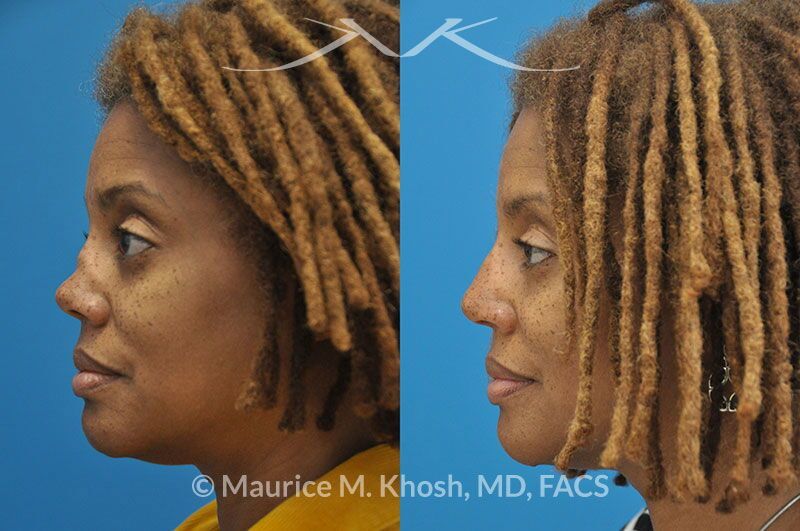
When the bony nasal bridge is under developed, the nose appears flat and washed out. This is common findings in Far-Asian and African ethnicities. Those with this nose type often desire a more pronounced nasal bridge that adds character to the facial appearance, especially from the side or oblique view of the nose. Increasing the bridge height through either surgical or non-surgical options can improve the appearance of the nose bridge for a more balanced facial appearance.