Droopy Nasal Tip Correction in NYC
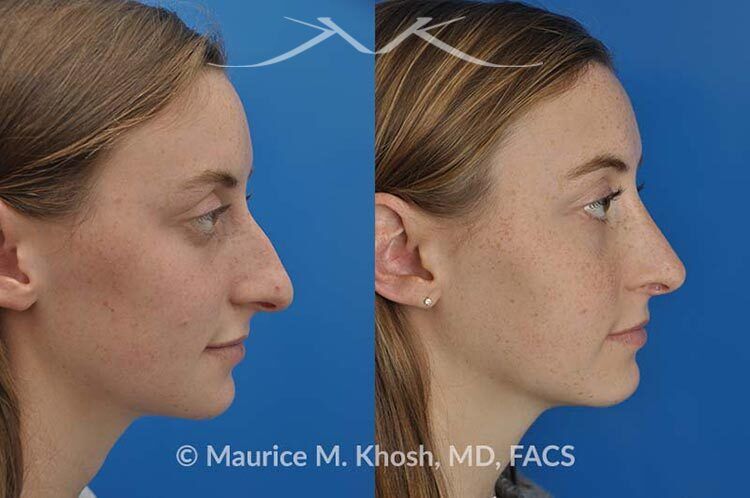
A drooping or “ptotic” nasal tip — sometimes called a hooked nose — is one of the more aesthetically conspicuous nasal concerns. The tip descends at a sharper-than-natural angle toward the upper lip, producing a profile that draws the eye and can affect facial proportion noticeably. The droopy tip is most visible from the side view, where the downward angulation is unmistakable, and it often becomes even more pronounced when the patient smiles. From the front view, a severe droopy tip can partially hide the nostrils and the upper lip. Patients seeking correction work with Dr. Khosh, a renowned New York Facial Plastic Surgeon and Rhinoplasty Surgeon in New York, uniquely qualified to address the specific anatomical causes of nasal tip droop.
Tip droop happens for several distinct anatomical reasons — the supporting cartilage may be weak, the septum may be too long, the tip may be over-rotated downward, or aging may have loosened the structures that hold the tip in its youthful position. Effective correction requires identifying which cause is responsible. Dr. Maurice Khosh’s three decades of rhinoplasty experience cover the full range of tip-specific surgical techniques required, including columellar strut grafting, cephalic trim, and septal shortening. Dual board-certified by the American Board of Facial Plastic and Reconstructive Surgery and the American Board of Otolaryngology–Head and Neck Surgery and a Fellow of the American College of Surgeons (FACS), Dr. Khosh holds active hospital privileges at NewYork-Presbyterian, Mount Sinai West, and the Manhattan Eye, Ear, and Throat Infirmary (MEETH), and has been recognized as a perennial Castle Connolly Top Doctor.
What Causes a Droopy Nasal Tip
Identifying the underlying cause of tip droop is the most important step in choosing the right surgical approach. Common causes include:
- Weak Supporting Cartilage: The lower lateral cartilages that hold the nasal tip in position may be inherently weak or thin, allowing the tip to descend over time
- Long Septum: An overly long nasal septum pushes the tip downward, producing a droopy appearance even when the tip cartilages themselves are otherwise normal
- Over-Rotated Tip Anatomy: Tip cartilages positioned at an over-rotated downward angle, often a congenital variation
- Age-Related Tip Ptosis: Gradual descent of the nasal tip with aging as the supporting tissues lose elasticity
- Smile-Induced Droop: A specific pattern where the depressor septi muscle pulls the tip downward during smiling, producing a tip that appears acceptable at rest but droops noticeably when the patient smiles
- Previous Surgery: Tip droop that emerged or worsened after prior rhinoplasty — often the result of inadequate tip support during the previous procedure
Non-Surgical Droopy Tip Correction with Dermal Filler
For patients with a mild droopy tip, non-surgical correction using dermal filler can produce a meaningful improvement without surgery. Filler products such as Restylane and Juvederm can be carefully placed at strategic points around the tip to reduce the angle of the droop and soften the visible downward angulation. The technique works by creating a subtle volume effect that visually re-rotates the tip upward without changing the underlying cartilage.
Limitations to understand:
- Effective Only for Mild Droop: Moderate to severe tip droop generally does not respond adequately to filler — surgical correction is the appropriate option
- Temporary Result: Filler effect lasts 9 to 18 months depending on the product, requiring periodic maintenance
- Cannot Address Functional Issues: Filler does not change the underlying cartilage or septal anatomy and cannot improve any associated breathing problems
- Best for Specific Patient Profile: Adults with stable nasal anatomy, mild visible droop, and tolerance for ongoing maintenance treatments
Surgical Correction for a Droopy Tip
For moderate to severe droopy tip — and for patients seeking a permanent correction — surgical rhinoplasty is the appropriate approach. The specific techniques selected depend on the severity of the droop and the underlying anatomical cause:
For Mild Droopy Tip
A closed rhinoplasty procedure can typically address mild droop, with all incisions placed inside the nostrils and no external scarring. The procedure may include:
- Septal Shortening: Trimming a small amount from the lower edge of the septum (the wall separating the nasal passages), which removes the structure that may be pushing the tip downward
- Columellar Strut Placement: A cartilage graft positioned between the tip cartilages to provide stronger support; the cartilage is typically harvested from the patient’s own septum
- Cephalic Trim: Removing the upper edge of the tip cartilage to allow the tip to rotate upward into a more youthful position
For Moderate to Severe Droopy Tip
For more significant droop, either the closed approach or the open approach (through a small columellar incision) may be appropriate, depending on the surgical complexity required. The procedure may include:
- Tip Cartilage Elevation and Suspension: The nasal tip cartilages are elevated and surgically suspended from the underlying septal cartilage, repositioning the tip into a higher, more youthful position
- Columellar Strut Placement: As with mild cases, a cartilage strut is used to provide lasting tip support
- Cephalic Trim: Cartilage trimming to allow the tip to rotate upward
- Tip Sutures: Specialized sutures that reshape and reposition the tip cartilages
- Depressor Septi Muscle Release: For patients whose tip droops during smiling, releasing this small muscle can dramatically improve the smile-related droop
“Tip ptosis correction is one of the most rewarding rhinoplasty procedures when it’s done correctly — the change is dramatic and the patient sees it from the first moment the splint comes off. But it’s also one of the procedures where shortcuts produce disappointing results. The tip needs new support — not just trimming of what’s already there. Without the structural reinforcement of a columellar strut or similar graft, the droop tends to return over time.” — Dr. Maurice Khosh
Droopy Tip Surgery Recovery
Droopy tip correction is typically performed under general anesthesia or deep sedation at an accredited surgical facility. The procedure usually takes two to three hours depending on the complexity. Patients return home the same day with a small external splint protecting the nose for the first week. Bruising and swelling are most pronounced during the first one to two weeks; the splint is removed at one week, and most patients return to non-physical work at this point. Tip refinement continues over the following several months as swelling fully resolves, with the final result becoming visible at approximately twelve to eighteen months post-surgery.
Why Choose Dr. Khosh for Droopy Tip Correction
- Three Decades of Tip-Specific Rhinoplasty: Refined expertise in the columellar strut, cephalic trim, and tip suspension techniques that produce lasting results
- Both Non-Surgical and Surgical Options: Honest recommendation of the right approach for each patient’s specific degree of droop
- Hospital Privileges Across Major NYC Institutions: NewYork-Presbyterian, Mount Sinai West, and MEETH
- Lasting Structural Correction: Use of cartilage grafting to provide new tip support, rather than only trimming existing cartilage
- Dual Board Certification: Combined facial plastic and head and neck surgery expertise
- Park Avenue Convenience: Private Upper East Side practice serving patients from across Manhattan and the tri-state area
Schedule Your Droopy Tip Consultation in NYC
If the appearance of a droopy nasal tip is affecting your facial profile — particularly if you notice the droop worsening when you smile — the first step is a thorough evaluation of the underlying anatomical cause. To schedule a private consultation with Dr. Khosh at his Park Avenue office in New York City, contact us today, or call (212) 339-9988.