Crooked Nose Correction in NYC
A crooked nose is one of the most noticeable nasal deformities — a curvature or deviation of the nasal bridge to one side or the other, most apparent when viewed from directly in front. Crooked noses are common in patients who have suffered nasal trauma — sports injuries, personal trauma, car accidents, or other injuries to the face that fractured the underlying bone or cartilage. Other crooked noses are congenital, present from birth as a developmental variation rather than the result of an injury. Either way, the curvature affects facial symmetry and often also affects breathing, since the same anatomical deviation that produces the visible crookedness frequently also affects internal nasal airflow. Crooked nose correction is one of the procedures within rhinoplasty and nose reshaping at Dr. Khosh’s Park Avenue practice in New York City.
A crooked nose can result from very different underlying causes — a deviation in the nasal bones, the cartilage, the septum, or some combination of all three — and effective correction requires identifying which anatomical structure is actually responsible. Dr. Maurice Khosh’s three decades of rhinoplasty experience cover the full range of corrective techniques required, from osteotomies for bony deviation to cartilage grafting for structural straightening. Dual board-certified by the American Board of Facial Plastic and Reconstructive Surgery and the American Board of Otolaryngology–Head and Neck Surgery, and an invited lecturer on non-surgical techniques at the 2023 Minimally Invasive ENT/Open Forum, Dr. Khosh is a Fellow of the American College of Surgeons (FACS) and a perennial Castle Connolly Top Doctor.
What Causes a Crooked Nose
A crooked nose can have several distinct underlying causes, and identifying the correct one is essential for choosing the right surgical technique:
- Nasal Trauma: Fractures to the nasal bones or cartilage that healed in a displaced position; common after sports injuries, falls, motor vehicle accidents, and physical altercations
- Untreated Childhood Injury: A childhood nasal fracture that was never evaluated or treated can produce permanent crookedness as the face continues to grow
- Congenital Deviation: Some patients are born with a crooked nose due to developmental variation in the bones, cartilage, or septum, independent of any injury
- Septal Deviation: A deviated nasal septum can pull the external nose toward one side, producing visible crookedness alongside internal breathing problems
- Previous Surgery: A crooked appearance that emerged after prior rhinoplasty, septoplasty, or nasal surgery — one of the more challenging categories to correct
- Growth-Related Asymmetry: Asymmetric development of the nasal structures during adolescence, sometimes worsening over time
Non-Surgical Crooked Nose Correction with Dermal Filler
For patients with a mild crooked nose — where the deviation is subtle and primarily aesthetic — non-surgical correction with dermal filler can produce a surprisingly effective improvement without surgery. Filler products such as hyaluronic acid (Juvederm, Restylane) or longer-lasting options can be carefully injected along the concave side of the crooked bridge, building up the depressed side to create a straighter visible outline. The technique works because the eye perceives straightness based on the visible silhouette of the bridge rather than the underlying bone structure — so adding volume to the depression makes the bridge appear straight even though the underlying bone has not moved.
Important limitations of non-surgical correction:
- Not Effective for Moderate or Severe Crookedness: When the deviation is significant, filler cannot adequately compensate; surgical correction becomes the appropriate option
- Does Not Address Breathing: Filler can only improve the external appearance — any associated internal nasal obstruction requires surgical treatment
- Temporary: Results last 9 to 18 months depending on the filler used and must be maintained with periodic treatments
- Specific Patient Selection: Best for adults with stable nasal anatomy and clearly defined mild deviation
Surgical Correction for a Crooked Nose
For moderate to severe crooked noses — and for any patient whose crookedness affects breathing — surgical correction is the appropriate approach. The surgical plan depends on which anatomical structures are responsible for the deviation, and may include any of the following techniques performed through either open or closed rhinoplasty:
- Osteotomy: Realignment of the nasal bones by making controlled cuts in the bone, then moving the bone segments into a straighter position; this is the foundational technique for correcting bony deviation
- On-Lay Graft: Cartilage grafts placed on the depressed (concave) side of the nose to camouflage the depression and create the appearance of symmetric bridge contour; the cartilage is typically harvested from the patient’s own septum, ear, or rib
- Spreader Graft: Cartilage grafts placed inside the nose, between the upper lateral cartilages and the septum, to move the cartilaginous bridge into a straighter position and simultaneously support the nasal valve for improved breathing
- Septoplasty: Correction of an underlying deviated septum, often the structural source of the crookedness; addressing the septum is essential to producing a lasting straight result
- Cartilage Reshaping: Direct reshaping of the cartilage structures of the nose when the deviation is primarily cartilaginous rather than bony
- Combined Techniques: Most crooked nose corrections require a combination of these approaches; addressing only one element while leaving others uncorrected typically produces an incomplete result
Open vs. Closed Approach for Crooked Nose Surgery
Crooked nose correction can be performed through either an open or closed rhinoplasty approach, with the choice depending on the complexity of the deviation:
- Closed Approach: All incisions placed inside the nostrils, leaving no external scarring; appropriate for simpler cases requiring osteotomy without extensive cartilage work
- Open Approach: A small incision on the columella allows direct visualization of the internal nasal structures; preferred for more complex deviations, cases requiring multiple cartilage grafts, and revision corrections
“Crooked nose correction is one of the procedures where diagnosis is most of the surgical plan. The same outward appearance — a nose that curves to one side — can come from a bony deviation, a cartilage deviation, a septal deviation, or all three. Surgical correction that addresses only one element while leaving the others in place will produce an incomplete result, and sometimes a worse one. Understanding which anatomical structure is actually responsible is what makes the difference between a satisfying outcome and a disappointing revision.” — Dr. Maurice Khosh
Crooked Nose Surgery Recovery
Surgical crooked nose correction is typically performed under general anesthesia at an accredited surgical facility. The procedure usually takes two to three hours depending on the complexity of the deviation and whether other rhinoplasty work is performed simultaneously. Patients return home the same day with a small external splint protecting the nose for the first week. Bruising and swelling are most pronounced during the first one to two weeks, with the splint removed at one week; most patients return to non-physical work at this point. Significant swelling continues to gradually resolve over the following months, and the final result — including the full straightness of the corrected nose — becomes visible at approximately twelve to eighteen months after the procedure.
Why Choose Dr. Khosh for Crooked Nose Correction
- Three Decades of Rhinoplasty Experience: Refined diagnosis and surgical planning across the full range of crooked nose causes
- Full Range of Techniques: Osteotomy, on-lay graft, spreader graft, septoplasty, and cartilage reshaping all available
- Both Non-Surgical and Surgical Options: Honest recommendation of the right approach for each patient’s specific degree of crookedness
- 2023 Non-Surgical Lecturer: Invited lecturer on non-surgical techniques at the Minimally Invasive ENT/Open Forum
- Functional and Aesthetic Integration: Surgical plan addresses both the visible crookedness and any associated breathing impairment
- Dual Board Certification: Combined facial plastic and head and neck surgery expertise
- Park Avenue Convenience: Private Upper East Side practice serving patients from across Manhattan and the tri-state area
Schedule Your Crooked Nose Consultation in NYC
If your crooked nose is the result of a previous injury, a long-standing congenital deviation, or a previous unsatisfactory surgery, the first step is a thorough evaluation of which anatomical structures are actually responsible for the deviation. To schedule your private consultation with Dr. Khosh at his Park Avenue office in New York City, contact us today, or call (212) 339-9988.
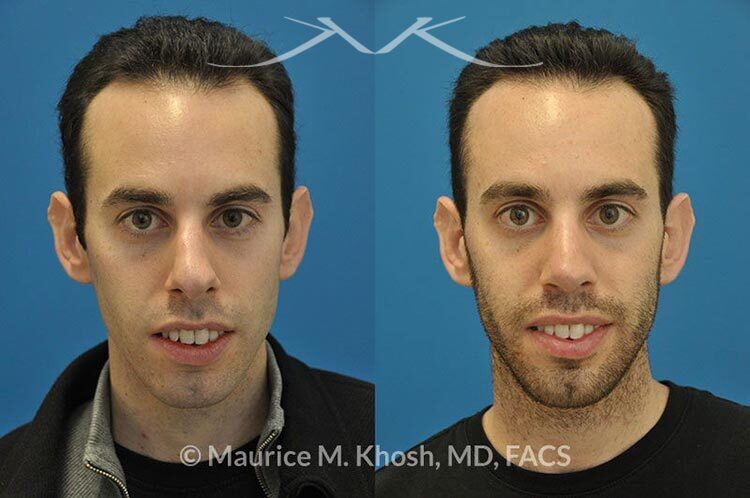
Crooked noses are common among those that have had their noses broken due to a sports injury, personal trauma, car accidents or other injury to the face. However, some crooked noses are defects in the way the nose was formed since birth, not caused by trauma. A crooked nose often has a curvature of the bridge that goes to one side or the other, most noticeable from the front view.
Click Here to See Broken Nose Repair, Facial Fracture Repair Photo Gallery