African American Rhinoplasty
Every ethnic group brings distinct nasal anatomy that affects how rhinoplasty is best planned and performed. For African American patients, the most common aesthetic concerns involve adding height to a low or flat nasal bridge, refining a wide or rounded tip, narrowing flared or wide nostrils, or addressing combinations of these features. African American rhinoplasty is performed as one of the procedures within rhinoplasty and nose reshaping at Dr. Khosh’s Park Avenue practice in New York City. Dr. Khosh is known as one of the leading facial plastic surgeons in New York City, with extensive experience treating patients across the full range of ethnic anatomies.
The goal of African American rhinoplasty is rarely transformation — it’s refinement. The procedure should improve specific aesthetic concerns while preserving the distinctive nasal features that define each patient’s ethnic identity and family resemblance. Dr. Maurice Khosh’s three decades of rhinoplasty work include extensive experience across the spectrum of ethnic anatomies, with refinement of approach that respects each patient’s individual goals. Dual board-certified by the American Board of Facial Plastic and Reconstructive Surgery and the American Board of Otolaryngology–Head and Neck Surgery and a Fellow of the American College of Surgeons (FACS), Dr. Khosh has been recognized as a perennial Castle Connolly Top Doctor and a Patients’ Choice Award recipient — and has been selected as “America’s Top Rhinoplasty Surgeon” by his peers.
Common Goals of African American Rhinoplasty
While every patient brings individual goals, several aesthetic concerns are frequently addressed in African American rhinoplasty:
- Increasing Bridge Height: Many African American patients have a relatively flat or low-projection nasal bridge; cartilage grafting or implant placement can add height for a more sculpted profile
- Refining a Wide or Rounded Tip: The lower lateral cartilages of the African American nose are often broader or differently configured than in other ethnic groups, contributing to a fuller, less defined tip
- Narrowing Flared or Wide Nostrils: Wider or more outwardly flared nostrils can be refined through alar base reduction (also called weir excision or wedge resection)
- Improving Tip Projection: Patients seeking a more projecting tip benefit from columellar strut grafts, septal extension grafts, or other tip-support techniques
- Functional Improvement Alongside Aesthetic Goals: Addressing breathing concerns when present, ensuring that surgery does not compromise nasal airway function
Anatomical Considerations in African American Nose Surgery
African American nasal anatomy has several common structural features that influence surgical planning:
- Lower Nasal Bridge: The bony bridge is typically positioned at a lower height than in some other ethnic anatomies, often requiring augmentation rather than reduction
- Wider Nasal Bones: The underlying bony framework may be wider at the base, contributing to the bridge appearance
- Thicker Skin: African American nasal skin tends to be thicker and more sebaceous than in some ethnic groups, which affects how the underlying cartilage changes translate to visible surface contour
- Softer Tip Cartilages: The lower lateral cartilages forming the tip are often softer or less defined, requiring different support techniques
- Wider Alar Base: The base of the nose is typically wider, frequently with more outward-flared nostrils
- Higher Risk of Hypertrophic Scarring and Keloids: African American skin has higher rates of hypertrophic scar and keloid formation, requiring careful incision placement and meticulous wound closure to minimize visible scarring
- Different Healing Patterns: Healing characteristics vary across patients but generally require attention to scar management
Preserving Ethnic Identity in Rhinoplasty
One of the most important conversations in African American rhinoplasty is about preserving — not erasing — the patient’s ethnic identity. Modern ethnic rhinoplasty has shifted significantly from the older approach of trying to make all noses look the same:
- Refinement Rather Than Replacement: The goal is improving specific features the patient is concerned about, while preserving the underlying character that defines the patient’s individual face
- Family Resemblance Preserved: Patients should still look like themselves and their family after surgery, with a nose that fits their facial structure rather than one that looks transplanted from a different ethnic background
- Patient-Defined Goals: Each patient defines what they want addressed and what they want preserved — the surgeon’s role is to deliver that specific result, not impose a universal aesthetic
- Honest Pre-Surgical Communication: Realistic conversation about what rhinoplasty can and cannot accomplish for a given patient’s anatomy
Surgical Techniques for African American Rhinoplasty
The specific surgical techniques used depend on the patient’s anatomy and goals. Dr. Khosh draws on a comprehensive range of approaches:
- Bridge Augmentation: Cartilage grafts (from the patient’s own septum, ear, or rib), diced cartilage in fascia, or manufactured implants to add bridge height
- Tip Refinement: Cephalic trim, dome binding sutures, columellar strut grafts, septal extension grafts, and shield grafts — used individually or in coordinated combination
- Alar Base Reduction (Weir Excision): Carefully designed wedge resection at the alar base to narrow nostril width and reduce flare, with incision placement hidden at the natural cheek-nostril junction
- Open vs. Closed Approach: Either approach can be appropriate depending on the complexity of the planned reshaping; open rhinoplasty (with a small columellar incision) is often used for complex tip work and bridge augmentation
- Cartilage Source Selection: Septum first when available; for patients requiring more cartilage than the septum can provide, ear or rib cartilage are excellent alternatives
“African American rhinoplasty has changed substantially over the years. The older approach often tried to take patients’ noses in directions that looked obviously surgical or that erased the patient’s ethnic features entirely. The modern approach is much more individualized — refining the specific concerns the patient brings while preserving the character that defines their face. The most satisfying results come when patients can look in the mirror and recognize themselves, just with the specific improvement they wanted.” — Dr. Maurice Khosh
Non-Surgical Options for African American Patients
For some patients with limited concerns about bridge height or specific irregularities, non-surgical rhinoplasty using dermal filler can produce meaningful improvement without surgery:
- Bridge Augmentation with Filler: Adding height to a low bridge through carefully placed filler
- Minor Irregularity Camouflage: Smoothing subtle surface irregularities
- Temporary Result: Effects last 12 to 18 months and require maintenance
- Best for Selected Patients: Most appropriate for patients with limited concerns who want to avoid surgery; not effective for wide tips, wide nostrils, or significant tip refinement
African American Rhinoplasty Recovery
Rhinoplasty is typically performed under general anesthesia at an accredited surgical facility. The procedure usually takes two to four hours depending on the complexity of the work, including any cartilage harvesting (which adds time for the donor site). Patients return home the same day with a small external splint protecting the nose for the first week. Bruising and swelling are most pronounced during the first one to two weeks, with the splint removed at one week and most patients returning to non-physical work at this point. Tip refinement and detailed contour continue to refine over the following several months, with the final result fully visible at twelve to eighteen months. African American patients often experience prolonged tip swelling due to thicker skin, so patience during the recovery is particularly important.
Why Choose Dr. Khosh for African American Rhinoplasty
- Three Decades of Ethnic Rhinoplasty: Extensive experience across African American, Asian, Hispanic, Middle Eastern, and other ethnic anatomies
- Identity-Preserving Approach: Surgical planning that respects the patient’s ethnic features rather than imposing a universal aesthetic
- “America’s Top Rhinoplasty Surgeon”: Peer recognition for excellence in rhinoplasty
- Full Range of Techniques: Bridge augmentation, tip refinement, alar base reduction, and combination approaches all available
- Functional and Aesthetic Integration: Every plan addresses both appearance and breathing function
- Scarring Awareness: Careful incision placement and closure technique to minimize visible scarring for patients with higher keloid risk
- Dual Board Certification: Combined facial plastic and head and neck surgery expertise
- Park Avenue Convenience: Private Upper East Side practice serving patients from across Manhattan and the tri-state area
Schedule Your African American Rhinoplasty Consultation in NYC
If you are considering rhinoplasty and want a surgeon who understands how to address your specific aesthetic concerns while preserving the distinctive features of your nose, the first step is a thorough consultation evaluating your individual anatomy and goals. Contact us today to schedule a private consultation with Dr. Khosh at his Park Avenue office in New York City, or call (212) 339-9988.
Meta Title: NYC African American Rhinoplasty | Dr. Khosh Meta Description: African American rhinoplasty in NYC with Dr. Maurice Khosh — dual board-certified facial plastic surgeon and selected “America’s Top Rhinoplasty Surgeon.” Call (212) 339-9988.
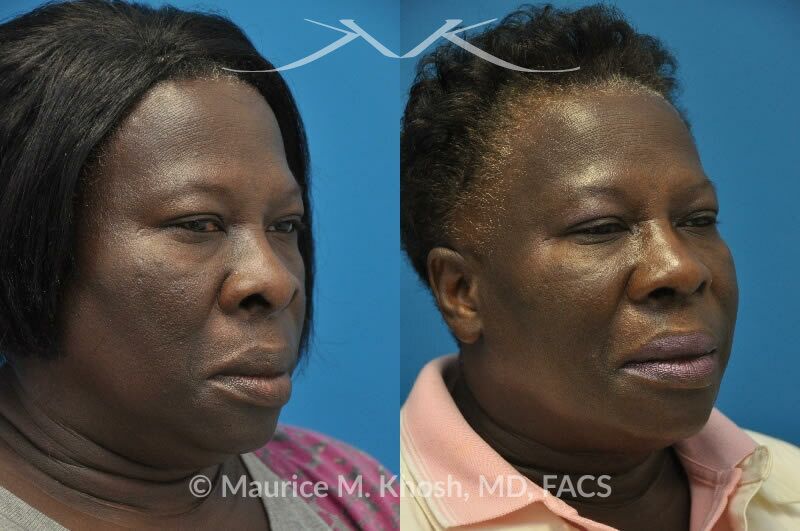
Case Study
55 year old lady was interested in cosmetic improvement of her nose. She desired a more defined and better projected nasal tip, with less flaring of the nostrils.
- Patient: 55 year-old lady interested in rhinoplasty in Manhattan
- Problem:
Flaring nostrils. Poorly defined and amorphous nasal tip. Under-projected nasal tip. - Procedure: >Rhinopalsty performed through the open approach to narrow the nostrils, reduce nostril flair, and narrow the nasal tip.
Disclaimer: These are actual results for patients of Dr. Maurice Khosh. Plastic and cosmetic surgery results can vary between patients.