Keloid Scar Treatment
Every skin wound heals by forming a scar — and the quality of that scar depends on several distinct factors. The size and location of the injury, the mechanism that caused it, the age of the patient, and most importantly, the patient’s genetic predisposition all influence how a scar will form and mature. For some patients, scars heal as delicate, imperceptible lines that fade with time. For others, the healing response is more aggressive than the wound requires — producing thickened, raised, sometimes massive scars known as hypertrophic scars or keloids. African Americans, Asians, and deeply pigmented people of all racial backgrounds are significantly more prone to developing keloids than those with fair skin, and the skin of the ears, jawline, shoulders, and central chest is particularly predisposed to keloid formation regardless of ethnicity. Keloid scar treatment is one of the procedures within facial reconstruction at Dr. Khosh’s Park Avenue practice in New York City.
Keloid scars are one of the few skin conditions where surgical removal alone is almost guaranteed to fail — without coordinated post-surgical treatment, the keloid simply grows back. Dr. Maurice Khosh’s approach to keloid management is built around exactly this reality. Dual board-certified by the American Board of Facial Plastic and Reconstructive Surgery and the American Board of Otolaryngology–Head and Neck Surgery and a Fellow of the American College of Surgeons (FACS), he has spent three decades developing the multi-modality approach this condition demands. Recognized as a perennial Castle Connolly Top Doctor, Dr. Khosh has built working relationships with dermatologists and radiation therapists to deliver coordinated care for difficult keloid cases.
Hypertrophic Scars vs. Keloids
Although the terms are sometimes used interchangeably, hypertrophic scars and keloids are different conditions with important distinctions for treatment:
- Hypertrophic Scars: Wide, thickened scars that grow within the boundaries of the original incision or wound; generally easier to manage and carry a lower risk of recurrence
- Keloid Scars: Scars that grow beyond the confines of the original skin incision or wound, sometimes dramatically; can grow to substantial size, causing both aesthetic concerns and emotional harm
- Functional Implications: Both can cause functional problems if they restrict skin movement, distort surrounding anatomy, or interfere with normal activities
- Aesthetic Implications: Both can be cosmetically distressing, but keloids — because they extend beyond the original wound — often cause more substantial visible change
Risk Factors for Keloid Formation
Several factors increase the likelihood of developing a keloid:
- Genetic Predisposition: A family history of keloid scarring significantly increases individual risk
- Skin Pigmentation: Deeply pigmented skin is associated with higher keloid rates across all ethnic backgrounds
- Ethnicity: African American, Asian, and Hispanic patients have notably higher rates of keloid formation
- Anatomical Location: The ears, jawline, shoulders, central chest, and upper back are predisposed regardless of patient ethnicity
- Wound Type: Surgical incisions, piercings, burns, vaccinations, and traumatic injuries can all trigger keloid formation in susceptible patients
- Age: Younger patients (typically under 30) tend to develop keloids at higher rates than older patients
Keloid Scar Removal
The right treatment plan depends on whether the scar is hypertrophic or keloid, its size, its location, and the patient’s history of recurrence. Dr. Khosh’s approach typically includes:
- Steroid Injections: For small keloids and hypertrophic scars, intralesional steroid injections can flatten and soften the scar without surgery
- Silastic Sheeting: Silicone gel sheets applied to the scar to support the maturation of normal scar tissue and reduce thickness
- Surgical Excision: For larger keloids or scars that have not responded to non-surgical treatment, the keloid is precisely excised with meticulous technique to minimize the new wound
- Combination Therapy: Surgical excision paired with steroid injections at the time of surgery and during follow-up to prevent recurrence — the standard approach for most keloid cases
- Radiation Therapy: For recurrent or large keloids that have failed prior treatments, surgical excision followed by carefully planned radiation therapy provides one of the most effective long-term solutions
- Pressure Therapy: Compression devices used after surgical excision in selected anatomical locations such as the ears
Why Keloids Require a Coordinated Approach
The defining challenge of keloid treatment is recurrence. Surgical excision alone — without follow-up treatment — leads to recurrence in a significant proportion of cases. The combination of surgery with steroid injection protocols, pressure therapy, or radiation therapy substantially improves long-term results. Dr. Khosh works closely with dermatologists for steroid management and radiation oncologists for the cases that require post-excision radiation, ensuring each patient receives the right combination of treatments at the right times.
“Keloid management is one of the few situations in facial plastic surgery where the surgical procedure is only the beginning. What happens in the weeks and months after surgery — the steroid injections, the pressure therapy, the coordinated radiation when necessary — is what determines whether the keloid stays gone. Patients who follow the complete protocol have outcomes that look entirely different from those who pursue surgery alone.” — Dr. Maurice Khosh
Why Patients Choose Dr. Khosh for Keloid Scar Treatment
- Multi-Modality Treatment Approach: Surgical excision paired with steroid injections, pressure therapy, and radiation when needed
- Coordinated Care Relationships: Working partnerships with dermatologists and radiation oncologists
- Three Decades of Keloid Management Experience: Outstanding success rates across hypertrophic and keloid scars
- Honest Recurrence Discussion: Realistic conversation about the importance of follow-up treatment and the commitment required for long-term success
- Dual Board Certification: Combined facial plastic and head and neck surgery expertise
- Park Avenue Convenience: Private Upper East Side practice serving patients from across Manhattan and the tri-state area
Schedule Your Consultation in Manhattan
If you are dealing with a hypertrophic scar or keloid — whether new, long-standing, or recurrent after a previous attempt at treatment — the most useful first step is an honest evaluation of the existing scar and a coordinated plan that addresses both the visible tissue and the underlying tendency for recurrence. Please contact us today to schedule a private consultation with Dr. Khosh at his Park Avenue office in New York City, or call (212) 339-9988.
Case Study
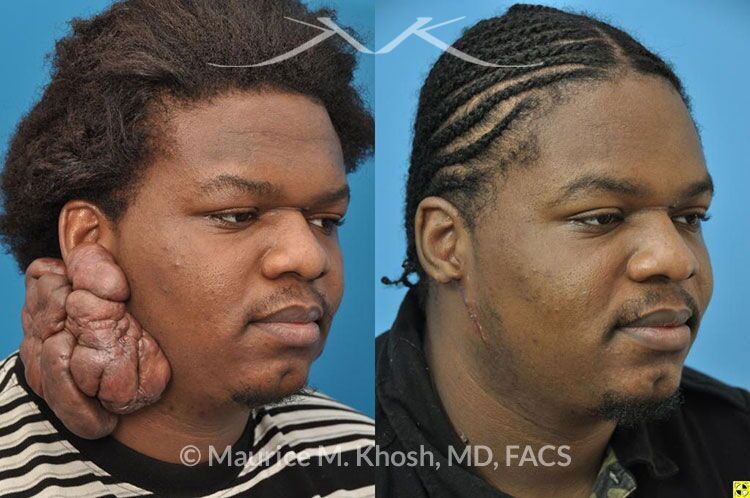
This 19 year old man sought treatment for large ear keloids. He had undergone multiple failed treatments of keloids on both ears. The massive keloids were successfully treated with surgical excision, followed by radiation therapy, and steroid injections.
- Patient: 19 year old man with recurrent bilateral ear keloids
- Problem: Massive bilateral ear keloids
- Procedure: Excision of keloids and repair followed by radiation therapy
Disclaimer: These are actual results for patients of Dr. Maurice Khosh. Plastic and cosmetic surgery results can vary between patients.
Frequently Asked Questions
-
The exact cause of keloids is not yet clearly described. The suspected problem is abnormalities in cell proliferation whereby the process of healing is not halted normally. Scar tissue continues to build, leading to large and unsightly scars. There are genetic factors that predispose patients to keloid scar formation. Hormonal factors also affect the risk of keloid formation. Because keloids tend to demonstrate accelerated growth during puberty or pregnancy and tend to resolve with menopause. Other hormones linked to keloid formation include thyroid hormone alterations and melanocyte-stimulating hormones.
-
This is a clinical decision that depends on the patient and the extent of the keloid. In general, three injections are recommended at one month intervals.
-
The pulsed dye laser has shown some benefit in treatment of keloids, through suppression of fibroblast proliferation.
-
There are widely reported success rates for treatment of keloids. Success rates vary from 50% to 90%. Keloid scars that have failed to resolve with standard therapies, such as excision and steroid injections, can respond to combination of surgical excision followed by radiation therapy.
-
Surgical excision is usually followed by one radiation session on the same day or the next day.
-
Hypertrophic scars are caused by excess tension across wounds. Other factors implicated in the etiology of abnormal scar formation include wound infection, a prolonged inflammatory response, and wound orientation different from the relaxed skin tension lines.
-
In patients who have keloids or history of keloids in their immediate family, it is advisable body piercing be avoided. In fact, all non-essential surgical treatments that violate the skin should be avoided.
Related Procedures
Keloids and hypertrophic scars are generally treated as stand alone procedures. Keloid treatment may require post surgical radiation therapy. In most cases, keloid and hypertrophic scars are treated with post surgical steroid injections on monthly basis.
Click Here to See Keloid Scar Reconstruction Photo Gallery