Ear Reconstruction Surgery in NYC
Ear reconstruction is among the most technically demanding subspecialties of facial plastic surgery. The ear’s three-dimensional architecture is unique among facial structures — an intricate network of curves, folds, and ridges built almost entirely on a delicate cartilage framework covered by thin skin. Rebuilding part or all of an ear, whether after congenital absence, trauma, infection, or cancer removal, requires not only surgical precision but a deep understanding of how cartilage, skin grafts, and tissue flaps work together to recreate a natural appearance. Ear reconstruction is one of the ear procedures Dr. Khosh performs at his Park Avenue practice in New York City, drawing on decades of focused ear surgical experience.
Dr. Maurice Khosh’s approach to ear reconstruction is shaped by a combination of published technical expertise and three decades of complex reconstructive practice. Dual board-certified by the American Board of Facial Plastic and Reconstructive Surgery and the American Board of Otolaryngology–Head and Neck Surgery, Dr. Khosh is a Fellow of the American College of Surgeons (FACS) and a Clinical Assistant Professor at Columbia University. He is the author of a peer-reviewed publication in the Archives of Facial Plastic Surgery — “Closure of Auricular Cartilage Harvest Site with Absorbable Quilting Sutures: A Novel Technique” — work that directly informs how he approaches cartilage harvest and grafting in reconstructive ear surgery. He has also authored a published chapter on tissue expansion, a technique frequently used in multi-stage reconstructive work to gradually grow additional skin for use in flap or graft procedures. Dr. Khosh holds active hospital privileges at NewYork-Presbyterian, Mount Sinai West, the Manhattan Eye, Ear, and Throat Infirmary (MEETH), and Lenox Hill Hospital — institutional credentialing that reflects ongoing peer review of his surgical practice. He has been recognized as a perennial Castle Connolly Top Doctor and a Best Doctors in America honoree.
When Ear Reconstruction Is Needed
Dr. Khosh is skilled in the reconstruction of ear deformity from any cause — from torn earlobes to missing auricles. The most common indications for ear reconstruction include:
- Microtia (Congenital Absence or Underdevelopment): Children born without a fully formed ear, requiring multi-stage reconstruction using rib cartilage to recreate a natural ear shape
- Trauma-Related Deformity: Significant injury that has resulted in partial or complete loss of ear tissue
- Cauliflower Ear and Collapsed Cartilage: Athletes or trauma patients whose ear cartilage has collapsed or scarred into an abnormal contour
- Keloid Deformity: Significant scar overgrowth that has distorted the natural ear shape and requires excision with reconstruction
- Mohs Skin Cancer Reconstruction: Restoring the ear after Mohs surgery has removed skin cancer from the auricle
- Burns and Infections: Loss of ear tissue from thermal injury or destructive cartilage infections (perichondritis)
- Torn or Avulsed Earlobes: Significant earlobe damage that requires reconstruction rather than simple repair
Surgical Techniques Used in Ear Reconstruction
Each reconstruction is individually planned based on the underlying defect, the surrounding tissue, and the patient’s overall goals. Dr. Khosh draws on a broad range of reconstructive techniques to achieve the most natural-looking outcome:
- Rib Cartilage Grafting: For microtia repair, healthy cartilage from the patient’s rib is carefully harvested and sculpted into a three-dimensional framework that mimics the natural ear shape
- Cartilage Shaving and Recontouring: For partially collapsed or distorted ears, precision shaving and reshaping techniques restore the natural curves and folds
- Skin Grafts: Thin layers of skin transferred from elsewhere on the body to cover reconstructed or grafted areas where skin coverage is needed
- Tissue Flaps: Local flaps from surrounding skin and tissue, rotated or advanced into the reconstructed area to provide both coverage and blood supply
- Tissue Expansion: A preparatory technique used in multi-stage reconstruction to gradually grow additional skin in the area adjacent to the reconstruction site
- Composite Grafts: Combined skin and cartilage grafts used in selected cases where both tissue types need to be replaced
“Ear reconstruction is where the full range of facial plastic surgery techniques come together — cartilage work, skin grafts, tissue flaps, sometimes expansion of nearby skin to give us enough tissue to close. Each case is different, and the plan has to be built around the specific defect and the surrounding tissue that’s available to work with. There is no template; it’s all judgment and experience.” — Dr. Maurice Khosh
Multi-Stage Reconstruction
Reconstruction of the ear is occasionally a multi-stage surgical effort to arrive at the maximum aesthetic result. This is particularly common in microtia repair, where the rib cartilage framework is implanted in one stage, the lobule is repositioned and ear is elevated from the side of the head in a subsequent stage, and finer refinements may follow over additional procedures. Skin grafts, tissue flaps, and cartilage grafts can be used at different stages to improve or augment the reconstructive effort. In the rare occasions that scalp skin is transferred to the ear as part of a flap, hair removal may be necessary as a related procedure to ensure the final appearance is natural.
Case Study
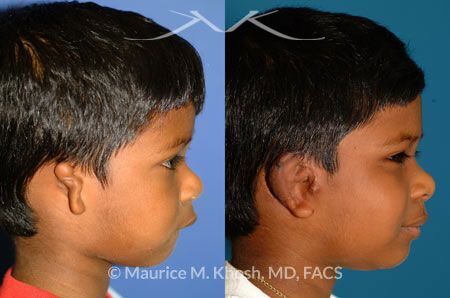
This 5-year-old boy had congenital under development of his ear, known as microtia. His ear was reconstructed with cartilage taken from his rib.
- Patient: 5-year-old boy
- Problem: Microtia, missing ear
- Procedure: Microtia repair with rib cartilage graft
Disclaimer: These are actual results for patients of Dr. Maurice Khosh. Plastic and cosmetic surgery results can vary between patients.
Frequently Asked Questions About Ear Reconstruction
-
Uncomplicated ear reconstructions such as repair of torn ear lobes, excision of keloids, or repair of small cancer defects can be comfortably performed under local anesthesia. More complicated ear reconstructions require sedation or general anesthesia.
-
Most patients can return to work within 10 days of ear reconstruction. Individuals who undergo simple office treatments such as repair of a torn ear lobe may return to full activities within a day. Patients undergoing more complicated ear reconstruction will experience swelling and bruising which may last ten days.
-
We recommend waiting 6 weeks or more after repair of a torn earlobe before re-piercing.
-
A wrestler’s ear deformity or cauliflower ear describes collapse and deformation of the upper cartilaginous aspect of the ear. The underlying cause of the deformity is a reoccurring collection of fluid between the ear cartilage and overlying skin that eventually leads to loss of cartilage and collapse.
-
Minimizing trauma to the ears will reduce the incidence of fluid collection, which is thought to contribute to this problem. When fluid collection is present, timely drainage will minimize cartilage trauma. Reconstruction of cauliflower ear deformity entails cartilage grafts and skin flaps.
-
A missing ear that results from congenital absence or trauma may be reconstructed through a multi-staged operation. Structural support of the ear is fashioned from rib cartilage or an implant. The skin is fashioned from transfer of adjacent tissues and skin grafts.
Related Procedures
Reconstruction of the ear is occasionally a multi stage surgical effort to arrive at the maximum aesthetic results. Skin grafts, tissue flaps, and cartilage grafts can be used to improve or augment the reconstructive effort. In the rare occasions that scalp skin is transferred to the ear, hair removal may be necessary as a related procedure.
Schedule Your Consultation in Manhattan
Whether you are seeking reconstruction for a child with microtia, after trauma, following Mohs cancer removal, or as a result of significant earlobe damage, the right outcome depends on detailed evaluation of the existing tissue, careful staging of the reconstruction, and the surgical experience to draw on the right combination of techniques. To schedule a consultation with Dr. Khosh at his Park Avenue office in New York City, call (212) 339-9988 or contact us online to request an appointment.